
-
Follow me on:
-
Category Archives: Books
Everything I Never Told You
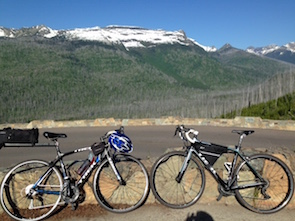
Last weekend, the Hub and I drove to Glacier National Park in Montana, staying for a few days to celebrate our anniversary. It’s a beautiful place where we love to bicycle and hike. The Going-to-the-Sun Road, which winds through Glacier Park for about 52 miles, is an awesome journey that makes its way over the Continental Divide at Logan Pass at 6,646 feet.

Near the top, the road narrows and tightly clings to the mountainside while taking you around some high tight turns. It’s a ride in places that’s not exactly for the faint of heart (like me). If you’ve ever seen the movie “The Shining,” the opening scenes and aerial shots are of this epic road, which sets the movie’s beginning perfectly, both for being isolated and a little ominous.

Luckily our trip didn’t include any spooky moments like those in “The Shining.” I did not run into Danny talking about “redrum” or see any twins in the corridors of our lodge. Thank goodness. Instead check out the photo at left of Lake McDonald, which is serene and beautiful and along which we lodged and spent most of our time. Just don’t fall in. I’m sure it’d be rather chilly.
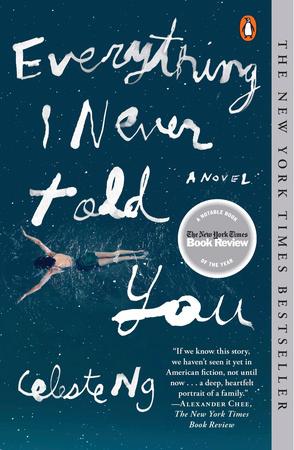
While there, I read Celeste Ng’s 2014 highly acclaimed debut novel “Everything I Never Told You,” which I picked for my book club to read and discuss after the novel was selected on many best-of lists last year. Perhaps I’m one of the last bloggers to read this quite sad but notable book? Luckily it generated a good discussion last night at book club. I think it’s because it delves into various issues that are still relevant today and consists of some characters and drama that can be argued over for quite a good long gathering.
It’s not giving anything away to say “Everything I Never Told You” is about a teenage girl (Lydia) who goes missing and is found drown in the local lake. That’s at the beginning of the book. The rest of it goes back in time, gradually laying out how she got there and why she died.
Set in a small Ohio town in the 1970s, the story explores Lydia’s close ties within her Chinese-American family who all feel like outsiders in their Midwest community. It delves into her parents’ backgrounds (her mother’s unachieved dreams of becoming a doctor, her dad’s humble and unpopular youth as a son of immigrant workers) and the views of her older brother and younger sister who are often ignored. In her parents’ eyes, Lydia is the favorite child who gets all the attention and is expected to achieve the unfulfilled dreams that they did not.
It’s an intense little book (292 pages) of an unraveling family and is a quick read. The author seems a natural, getting into the heads and backgrounds of all, while the pages flip by easily. It’s a sad and tragic story. Everyone in the family fails to communicate truthfully with one another, keeping secrets that ultimately have such regrettable consequences. I liked the many issues that this book touches upon which felt real to me, namely: the pressures kids and parents put each other through; women’s roles in society and unfulfilled dreams; being an outsider and feelings of inadequacy for those of mixed-race ethnicities — and on the flip side of that — the whole stifling, homogenized world of 1970s small-town America is effectively displayed in the book.
It’s agonizing at times how aggravating the characters can be and how suffocating the setting is. If only they would do this and this and this! — you think. But no, they don’t. Still you feel compelled by where their lives have taken them. You sympathize. It’s impossible not to. Despite whatever your minor quibbles, you must hear this novel out. For a slim debut, I felt it packed a lot of issues in. I’ll definitely be looking for whatever novel author Celeste Ng puts out next.
What about you have you read “Everything I Never Told You,” and if so what did you think? Continue reading
Posted in Books
27 Comments
All the Light We Cannot See
Wow the trailer to “The Martian” came out this week and Matt Damon is Mark Watney! For those who read Andy Weir’s 2014 bestselling book, you know what I’m talking about … The red planet. The astronaut left behind. The rescue plans he comes up with. With Ridley Scott directing, the movie adaptation, coming out at Thanksgiving time, is going to rock! I reviewed the novel “The Martian” in April 2014 and was sure it’d make a heck of a movie. I just didn’t realize how quickly it would be made. Check out the preview
https://www.youtube.com/watch?v=Ue4PCI0NamI
and let me know what you think.
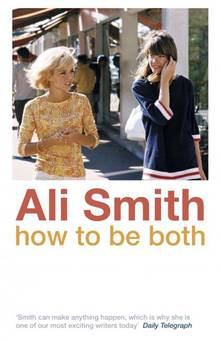
Also this past week, congrats to Scottish author Ali Smith for winning the Baileys Women’s Prize for Fiction for her 2014 novel “How to Be Both,” which the New York Times describes as “an innovatively structured novel about a young girl in modern-day England and a painter in Renaissance Italy.” I’ve heard mixed things about the book, which apparently is poetic and challenging and not for everyone. Author Sarah Waters was the odds-on favorite to win the prize for her bestselling novel “The Paying Guests,” but alas didn’t win it, which surprised me.
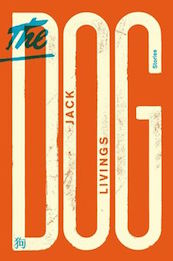
Also congrats to Jack Livings for winning the PEN/Robert W. Bingham Prize for Debut Fiction for “The Dog,” a collection of short stories set in China. New York Times writer Michiko Kakutani says the collection opens a “prismatic window on China, showing us how part of the country is rushing to embrace the 21st century, even as its history continues to exert a magnetic hold over people’s thinking and expectations.” Hmm. I haven’t heard if many bloggers have read this collection yet, but it sounds like one to behold.
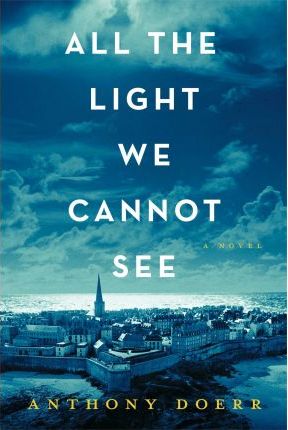
Meanwhile though it seems I’ve been away from the blog for a while, it’s just that summer has become busy and I was up to my eyelids in Anthony Doerr’s 2014 Pulitzer Prize-winning novel set during World War II “All the Light We Cannot See.” Need I say more? It’s a long war. Awful. I was on the sixth floor of the house in Saint-Malo, France, hiding with blind 14-year-old girl Marie-Laure and hoping she was going to make it. She was at her reclusive uncle’s house so close to the sea, where she liked to visit a nearby grotto that had barnacles and snails on its walls, which I could see blind Marie running her hands over. I was also imagining 16-year-old orphan, German soldier Werner in the Opel truck driving across the Occupied countryside tracking the resistance through his radio receiver. But the toll the results take on him, sets him off on a different course. I knew these two protagonists’ paths would cross towards the end, but heck what would happen to them then?
I had to hurry to find out, but it took awhile to get there. Anthony Doerr’s book is quite an epic read (530 pages) that goes back and forth in time and alternates Marie-Laure’s story with that of Werner’s into short chapters. There’s also a storyline about a large valuable diamond — apparently cursed — that Marie finds from her father after he is arrested and a Nazi who is pursuing the gem.
I liked the book quite a bit (though maybe didn’t love, love, it) and found it vivid and visual of the historical time period. It’s excellently weaved together with some elegant prose. I felt for the characters and finished the book as if I had endured the war too — emaciated, sleepless, and a mess from death, bombs, and trying to avoid Nazi capture. I particularly liked the radio aspects of the story — how radio transmitters were used by both sides — and how Werner’s passion for radios and science and Marie’s passion for Jules Verne’s “Twenty Thousand Leagues Under the Sea” eventually brings them together. It’s wonderfully imagined. I liked how it transported me to these young characters lives behind enemy lines. Although I think it could have been cut 80+ pages shorter and put into longer chapters. I’m still wondering too about the ending — was it enough? It feels quite fleeting and maybe not what you want but perhaps that’s exactly the way pivotal things in life go sometimes.
What about you have you read “All the Light We Cannot See,” and if so what did you think? Continue reading
Posted in Books
24 Comments
Euphoria
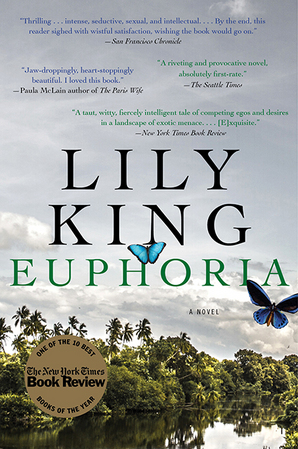
I didn’t realize I had been sucked into Lily King’s 2014 novel “Euphoria” until the end of the book — and then I was a sad wreck for the characters, as if it were a true story and I had lost touch with people I had known quite well.
Interestingly, author Lily King bases the characters on a brief time out of American anthropologist Margaret Mead’s real life story. It was a period of five months in 1933 when Mead and her second husband took a field trip to study the native people along the Sepik River, in New Guinea. There, they collaborated with the man who would become Mead’s third husband, the English anthropologist Gregory Bateson. See the photo of the three of them below, as they were in 1933.
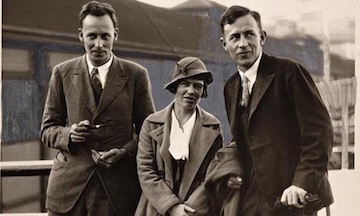
King takes this situation and setting and then develops a unique story for three anthropologists that is all their own. In the book, it’s Fen and Nell that are married, and Englishman Andrew Bankson who meets them while researching a tribe alone in New Guinea in 1933. Much of the novel delves into the three anthropologists hard at work, and their professional ambitions, studying the human behavior of the river tribes in the jungle. To me it was helpful to have an interest in anthropology to be intrigued with the book as it spends considerable time on the tribes’ behavior.
At the same time the story is also about the love triangle that develops between anthropologists Nell, Fen, and Bankson, and this undoubtedly is the most alluring part of the story. It’s cleverly done: how they’re exploring human behavior while dancing around their own. It’s raw and primitive in the field, and at times, sickness, remoteness, and ambition tightly bring together the three anthropologists and at other times cloud their judgements.
The novel’s well researched and vividly conjures up the settlements, the insects, the dirt, the native peoples, the scientists’ dress and equipment in 1933. The imagery is so visceral it’s as if you’re with them amid the jungle and can breathe the dense humid air.
It’s lonely Bankson, too, that makes the story come to life. A bright, sympathetic soul, he narrates the book mainly — combined with some field notes from Nell — and inevitably draws you into their world one step at a time. You feel him falling for Nell from the day he meets her. But she’s with Fen, who he’s also close to, and their lives and work are complicated. It’s a threesome that works, but also doesn’t. Three makes a crowd so they say.
I don’t think I foresaw the exact ending of the novel. Would Bankson and Nell wind up together, Fen and Nell break apart, or any of them make their mark from their research on the tribes once they returned to civilization? I went down their path, hoping for the best for each, but was quite saddened by the end, which is all I can say about it.
“Euphoria” is a vivid, real-feeling story that moves along faster toward the end. Its denouement will definitely stay with me for a long while. No wonder the New York Times chose it as one of the 10 best books of 2014. The novel takes a historical setting but then creatively flies off in an another direction, all the while touching on some of the drives and desires of the human experience. See Lily King’s illuminating essay on how she came up with the story here.
How about you have you read “Euphoria” and if so what did you think? And by the way, what are you up to this Memorial Day weekend?! Continue reading
Posted in Books
26 Comments
A God in Every Stone
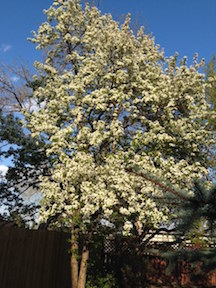
Spring continues to unfold here. More trees are in bloom and I’ll be planting the annual geraniums and other flowers soon. Meanwhile the hub and I are training on the side for a couple of upcoming bike ride events that we optimistically signed up for. Hopefully they won’t kill us. So we are bicycling most weekends over hill and dale. It’s nice but also a bit exhausting.
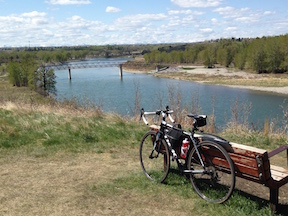
See my chariot at left. Our first event takes place in the mountains next weekend so I’ll try to take some good photos to post. Meanwhile below is a review of the book I finished this week.
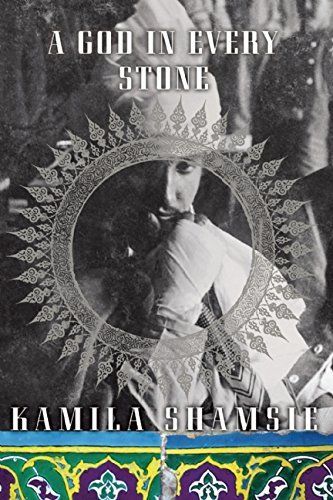
I don’t think I knew exactly what I was getting into when I picked up Kamila Shamsie’s 2014 novel “A God in Every Stone.” I got it at the library after it was shortlisted for the Baileys Prize for Women’s Fiction and the Walter Scott Prize for Historical Fiction, both of which will announce their winners in early June.
I thought “A God in Every Stone” would be a bit of a love story about a couple of archaeologists from different backgrounds, searching ancient ruins, during tempestuous historical times. Maybe I thought it’d be a bit like Lily King’s 2014 novel “Euphoria.” Sure the novel starts out like that but then it focuses more on the struggle for Indian independence, spanning World War I to the waning days of the British Empire.
In the novel, Vivian Rose is a young British woman who goes to Turkey in 1914 on an archaeological dig and ends up falling for an older Turkish archaeologist who’s searching for a silver circlet from the early days of the Persian Empire. All seems good and on track, but then World War I intervenes and she loses touch with her love. She spends most of the war as a nurse, witnessing horrific casualties.
Years later she travels to the Peshawar Valley (part of India then), continuing the quest for the mysterious silver circlet. She meets two brothers there, one a Pashtun soldier who fought for Britain in WWI, losing an eye, and a much younger boy who becomes her pupil and many years later an archaeologist who takes up her search for the silver circlet. The older brother gets caught up in India’s independence movement and the younger one eventually does at the book’s end when a massacre in 1930 by the British Army of nonviolent protestors brings things to a brutal head.
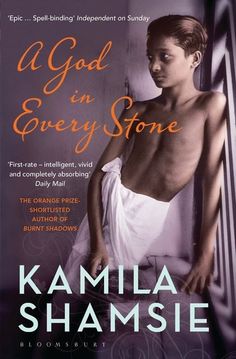
“A God in Every Stone” is a novel with a wide scope, a sweeping history, and it encompasses ideas about Indian independence, ethnic differences, the suffragist movement, and the Armenian genocide among other things. I found it best in its vivid atmosphere of the times and place, and many of its eloquent passages. No wonder author Kamila Shamsie was included on the Granta list in 2013 as one of Britain’s 20 best young writers today. Interestingly, she grew up in Karachi, Pakistan, and just recently became a British citizen, who now resides in London.
The troubles I had with the novel were that I was sometimes confused by the foreign names and geography of where they were, and a bit of the history and circumstances. Happenings were assumed perhaps and not explained at times. Luckily I finally found a map at the back of the book, which would’ve helped earlier if I’d seen it at the front of the book. Also I seemed to get into the characters, only to have their personal stories dropped later. Vivian Rose and the brothers were intriguing but then the closeness to them and their perspectives were lost along the way. So unfortunately I had to concentrate pretty diligently to finish the book. It wasn’t an easy read. It’s sweeping and at times disjointed. I’m glad I read it though. It gave me more perspective on a region I don’t know enough about and a feel for the turbulent days under colonialism.
How about you — have you read or heard of this author before? Or what is one of your favorite historical fiction books?
Posted in Books
10 Comments
Apron Strings
[Disclosure: This self-published novel was sent to me by New Shelves Distribution for review.]
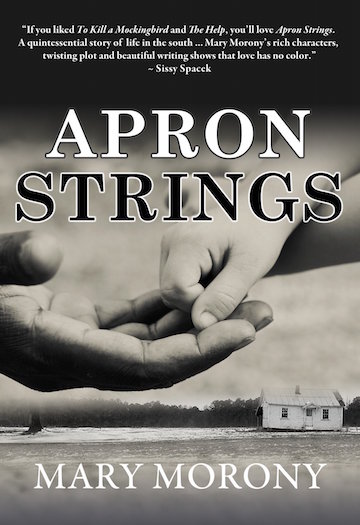
Where we would be without the dysfunctional families in Southern lit? We’d miss out on the protagonists in “The Great Santini,” “Bastard Out of Carolina,” and the stories of William Faulkner and Tennessee Williams to name just a few. Mary Morony’s debut “Apron Strings” is another in that grand tradition of Southern families run amok. As Kirkus Reviews writes “Apron Strings” is about “a white Virginia family in the late 1950s that struggles to stay together while enduring a failing marriage and racist neighbors.” The parents employ a black maid, Ethel, who cares for the four Mackey children, ages 14, 9, 7, and 4 as the book begins. It’s the third child, Sallee, 7, who narrates most of the book, chronicling two years of a home life that’s not exactly 1950s Happy Days.
The problem is the mother is harsh and often neglectful, and the father is mostly away at work. The kids, especially Sallee, must rely on Ethel for everything — meals, dressing, supervision, love — you name it. Ever-curious Sallee pesters Ethel with questions about her mother’s life and her life when they first met years ago. Ethel though has her own problems and secrets, which become more clear in the intermingled chapters that she narrates. You get her much-sought perspective though her dialect isn’t always easy to understand.
It’s a 1950s household that is stifling and toxic — amid a town where schools, restaurants, and theaters are racially segregated, and overt racism and violence exist. Author Mary Morony vividly permeates the story with the atmosphere of the times, pinpointing everything from the culture and uptight manners to the pervasive cigarette smoking and the endless high ball drinks and alcoholism. Apparently Morony’s story comes from her own childhood in which she was born and raised in Charlottesville, Va., by her family’s black maid, who she says: “taught me love and acceptance with warm, loving humor and unending patience.”
I found “Apron Strings” an easy book to fall into. The young Sallee is an endearing narrator and the dialogue sounds just right. Sallee’s often trying to keep up with her brother Gordy and learns the hard way after a couple incidents to stay clear of the neighbors house. (I couldn’t help but be a bit reminded of Scout and Jem and Boo Radley’s dilapidated place in “To Kill a Mockingbird.”) But I eagerly followed along to find out what would happen to the Mackey family — if they would split apart and disintegrate or how it would conclude. Divorce back then was a terrible taboo, and what the kids go through pulls them in various directions. It’s not an action-packed book so to speak, the kids often sit around the house on pins and needles, with a mother that’s unavailable or cannot be disturbed and a black maid that’s busy working. At times the ebbs and pulls are more psychological and heart-tugging in nature — as most good dysfunctional family stories are.
For readers looking for a big story arc and climax with tied-up resolutions at the end, “Apron Strings” might be a bit disappointing, just judging by some of the comments on Goodreads. The novel reads at times like it’s chronicling a slice of the kids’ lives when times were very tough during their childhood. By the end, there’s loose ends that remain a bit loose and not all is resolved — there’s not a showdown between the mother and kids, or between the past and present, or any justice against the racist neighbors. It’s a subtle ending, and one that harkens back to the maid’s presence in their lives to pull them through. For me, the vivid atmosphere and Sallee’s narration resound powerfully at times, making it a moving novel through harsh times in the South of the late 1950s. I liked the book and the childhood journey it takes through its minefield of familial and societal mores.
How about you — have you read or heard of this novel, or what is your favorite book about a dysfunctional family?
Posted in Books
2 Comments
Spring Days
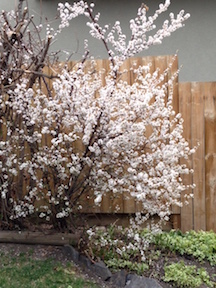
Leaves and buds are just opening here, and it’s been a productive couple of weeks of home and yard projects. I’m excited that I might be able to do my spring planting earlier this year as the weather is being fairly cooperative. I almost forgot how nice spring can feel. We plan to take a long bike ride in the backcountry on Sunday.

The town here is all abuzz about the NHL hockey playoffs since our team can clinch a first-round series win tonight at home, if only they would. I’m hoping it doesn’t prove elusive. In terms of playoff hockey, it’s been a long dry spell here and the dream of another round is within reach. And from what I’ve learned: never underestimate hockey in a northern country.
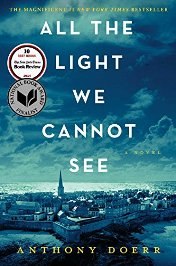
Meanwhile this week I want to congratulate author Anthony Doerr for winning the 2015 Pulitzer Prize for Fiction for his World War II novel “All the Light We Cannot See.” My Dad gave me this book for Christmas, and I’m excited to dive into it this spring. It’s waiting for me on the shelf, and I’ve heard from others how good it is. Set in occupied France, it interweaves the story of a blind 14-year-old French girl and a young German soldier whose lives cross paths toward the end of the book. I hear it’s terrific. Have you read it?
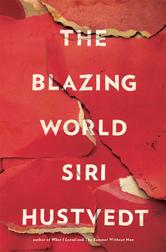
Also congratulations to Siri Hustvedt who just won the 2014 Los Angeles Times Book Prize for Fiction for her novel “The Blazing World.” According to the publisher, it tells the story of an enigmatic artist who, after years of having her work ignored, ignites an explosive scandal in New York’s art world when she recruits three young men to present her creations as their own. Yet when the shows succeed and she steps forward, one of the men betrays her and they get involved in a deadly game. I remember Barbara over at the blog wellwell touting this novel, and I’m sure it’s great as years ago I recall being pretty blown away by Hustvedt’s 2003 novel “What I Loved.” Her latest one seems to be brimming full of ideas, and Booklist calls it a “wrenching novel of creativity, identity, and longing.” Count me in for it.
In other book news, I came across a few cool articles this week that I thought I’d pass along. The first one in The Washington Post titled “I read books by only minority authors for a year. It showed me just how white our reading world is” by Sunili Govinnage definitely caught my eye. It makes a lot of strong points about the importance of reading diversity, and it seems like a great idea to take a year and read such a book list. I expect I’d explore novels in a number of countries and learn a lot. It seems a worthy, interesting goal.
The next article, “Owning a bookstore means you always get to tell people what to read,” is another good one by Ann Patchett, which was in The Washington Post. It extols the many joys of recommending books to people. I’m sure that’s why so many people like blogging about books. And many of today’s bloggers, like me, also worked in bookstores or the publishing industry along the way. Many still get a kick from pushing good reads.
The last article, “Romanticizing the Reader” by Diane Ackerman in the New York Times is a neat one about how “readers and writers provide a kind of outside family for one another” and that she sees the “reader as a collaborator” who “leaves individual imprints on a book they have read.” Just as a reader might romanticize an author so too does an author romanticize a reader. There’s “something inevitable and touchingly human about it,” she says. If you have time, you might want to check these articles out.
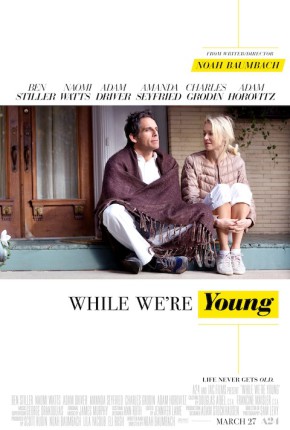
Meanwhile, the Noah Baumbach indie movie “While We’re Young” just made it to our neck of the woods and we saw it Friday night. It’s quite an enjoyable comedy about a mid-forties New York married couple — played by Ben Stiller and Naomi Watts — whose staid lives change when they start hanging out with a young hip couple they meet — played by Adam Driver and Amanda Seyfried. Oh the film is funny, but it also touches on some truths about parenthood, friendship, ambition and aging that its viewers likely have had. It speaks to middle-agers mostly, but can be enjoyed by a variety perhaps. It reminded me a bit of an old Woody Allen New York comedy about married couples, and I liked it more than I thought I would.
It’s definitely my favorite Noah Baumbach movie so far … if you’ve seen “Frances Ha” (2012), “Greenberg” (2010), “Margot at the Wedding” (2007) or “The Squid and the Whale” (2005). They’re all sort of quirky, but in those earlier ones the protagonists are usually sort of grumpy and not very likable. “While We’re Young” is more accessible and the main characters are more sympathetic. It’s both funny and interesting and includes a great cast. Kudos to Ben Stiller for his best role in years? Something tells me I should go back and rent “The Secret Life of Walter Mitty” — just to see his facial expressions.
What about you — have you read any of these books or seen any of these movies — and if so, what did you think? Continue reading
Posted in Books, Movies
14 Comments
A Recap and Fleetwood’s Story

Well tax week came and went — I survived it. April 15 is definitely a dreaded time each year. I have the joy of filing returns in two countries. Historically it’s not a great day either as both President Lincoln was killed and the Titanic sank on what’s become tax day. Also it’s the anniversary of the Oklahoma City bombing today (April 19), which was simply horrifying. I remember where I was when it happened — I was at work in the Longworth House Office Building in Washington D.C. where I interned for a Congressman when I was on a break in between jobs. We turned on the TV when we heard. It was awful and shocking. After that, legislation was passed to increase protection around federal buildings to deter future terrorist attacks. Today, 20 years later, it’s sobering to remember the 168 victims, including the 19 young children who were in the building’s day care facility. Who can forget. It’s a sad day to remember.
In much brigther news, this weekend is the Los Angeles Festival of Books. I’ve always wanted to go, but I’ve never gone! I simply must G-O some year soon. I checked the schedule and here’s just a smattering of authors they have at various book discussions going on: Hector Tobar, A. Scott Berg, Meg Wolitzer, Maggie Shipstead, Mona Simpson, Per Petterson, Peter Heller, Viet Thanh Nguyen, T.C. Boyle, Bich Minh Nguyen, Lisa See, Jenny Offill, Laird Hunt, Dennis Lehane, Jonathan Lethem, Kimberly McCreight, Jill Alexander Essbaum, Joyce Carol Oates, Malcolm Gladwell and Atticus Lish. Ugh I can’t believe I’m missing it once again. I need to plan in advance next time and get a flight to SoCal to visit my folks and attend the festival. There’s such literary star power there. Have you ever been?
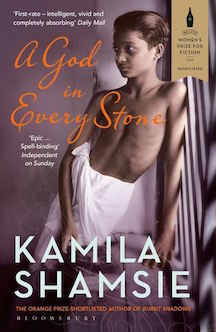
In other book news, the shortlist for both the Baileys Prize for Women’s Fiction and the PEN/Robert W. Bingham Prize for Debut Fiction were announced this past week. The Baileys shortlist includes the two heavyweights: Anne Tyler for “A Spool of Blue Thread” and Sarah Waters for “The Paying Guests.” Could it be Sarah’s year? The rest of the shortlist authors include — Ali Smith, Rachel Cusk, Laline Paull, and Kamila Shamsie — who aren’t too shabby either. I have Shamsie’s novel “A God in Every Stone” on hold at the library. The PEN shortlist includes Cynthia Bond’s “Ruby” and Phil Klay’s “Redeployment” along with three others. Have you read any of these? Stay tuned for the winners in May and June.
Meanwhile in reading this week, I picked up Jane Smiley’s novel “Some Luck” and 20 pages later I put it down. It felt staid to me though I’m sure I need to give it more time. I struggled with its style, though I wanted to read the trilogy its apart of. It’s sort of a bummer like Janet Maslin of the New York Times saying of Ann Packer’s new novel: “So the long, aimless slog through “The Children’s Crusade” begins with not that fascinating a family. And it ends with not that revelatory a resolution.” A slog?! Oh no, I so wanted to read Packer’s book too!
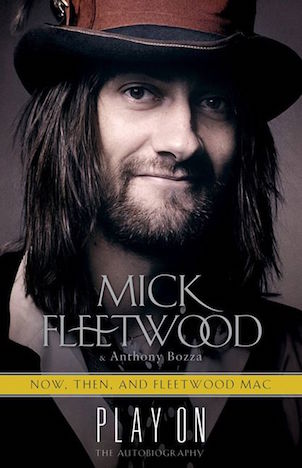
But instead of Smiley, I picked up a rock autobiography by Mick Fleetwood that I received for Christmas and consumed it. My brother gets me a good one almost every year. Over the years I’ve read books by or about: Bob Dylan, the Beatles, Janis Joplin, the Doors, Bruce Springsteen, Eric Clapton, Graham Nash, and Neil Young among others. I’m still saving Keith Richards’ autobiography and Patti Smith’s “Just Kids” for a super storm weekend in the future.
Anyways, Mick Fleetwood’s book with Anthony Bozza “Play On,” which came out last fall, did the trick. This week, I relived the years of Fleetwood Mac and the mega-selling albums the band put out especially with its self-titled album in 1975 and with “Rumors” in 1977, which sold more than 40 million copies worldwide —one of the best-selling of all time. This was before the days of CDs or iTunes. Back when people still bought albums. You might recall? On vinyl too. Both albums include such an array of hits which have become ingrained in the brain from all the radio airplay they received decades ago.
Fleetwood’s book follows his life with the band and the many incarnations and highs and lows the band went through from its inception in 1967 through to the present. There were quite a few different musicians in it over the years, but the same 1975 members are still touring as Fleetwood Mac today. I missed seeing them in concert a couple times over the years. But their history as a band is quite notorious from their early days —because of their epic touring, various relationships, endless recording sessions, non-stop drug habits, and rock-star lifestyles.
Mick’s lucky to be alive for sure. His book touches upon each period the band went through as well as his personal life that included: three failed marriages, two bankruptcies, and a two-year affair with Stevie Nicks of which he said: “in terms of the intensity it was a proper Hollywood affair on a par with Richard Burton and Elizabeth Taylor.” (Really? Come on). You name it, he went through it. Though in the book he seems rather at peace with it all. Like he’s making amends to people and himself for the crazy life he’s been through. As if it’s all pudding under the rug for a legendary rock ringleader who did his best to keep the band together.
So “Play On” is definitely very readable. You claw your way through it rapidly, reliving the band’s years, albums, and foibles. I especially liked when he discusses the songs and which band members created them and what they were about and how the band made the various albums. A song like Stevie Nicks’s “Sara” for example was apparently about how Mick took up with Nicks’s best friend Sara (she became wife #2) and it also might be about an unborn child she conceived with Don Henley. Oh my, you figure it out. Each band member brought such different things to the table, which in the end made the collaborations so successful. It was cool to read about their hit songs that so flooded the radio airwaves back then.
But unfortunately at times “Play On” seems to gloss over certain aspects of the band’s story and reads in places like a general outline of its trajectory. Some decades fly by while others are discussed more carefully. I only realized later that apparently much of Mick Fleetwood’s story was told in an earlier autobiography in 1990. This is his second one, which apparently goes over much of his and the band’s same history. How strange. He wanted to tell the story twice, this time it appears more sobered up and a bit more apologetic perhaps. It’s an entertaining read, but didn’t break a lot of new ground for me. As far as rock biographies go, it’s pretty standard fare but not as exemplary as perhaps Keith Richards’ or Patti Smith’s will be. Hooray the rock book genre will never die. They’re perfect reads for when you’re in between novels, or just curious about rock legends, their catapulted lives in the stratosphere, and classic songs of the rock era.
What about you do you recall the heyday and songs of Fleetwood Mac, or do you have a particular music autobiography that’s been a favorite?
Posted in Books
20 Comments
The Weekly Recap
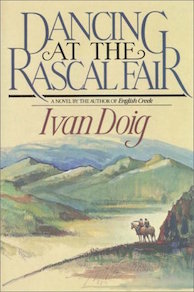
This week I was sad to read of the death of acclaimed author Ivan Doig of cancer at 75. Most of his books are set in Montana where my brother lives and he was one of my brother’s favorite writers. Doig was known for such novels as “Dancing at the Rascal Fair” from 1987 and the memoir “This House of Sky: Landscapes of a Western Mind” from 1979. He was referred to as “the dean of Western writers,” but he didn’t like being limited as a regional author. There’s still a slew of his novels that I want to read. Have you read any of his books, and if so, what did you think?
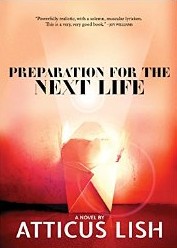
Also this past week congrats to author Atticus Lish for winning the 2015 Pen/Faulkner Award for Fiction for his novel “Preparation for the Next Life.” I had not heard of this book before — it’s from the small press Tyrant Books — but I’m very glad to be introduced to it. Set in New York City, the novel follows the unlikely love story between a Chinese Muslim immigrant and a traumatized Iraq War veteran. It’s been called a stunning debut, so I’m eager to check it out. Have you read or come across this title yet?
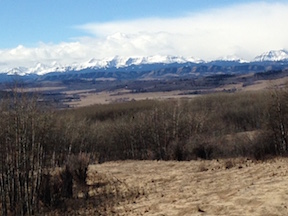
Meanwhile we’ve had some spring-like weather here and I was able to go for a few bike rides this week (see attached photo). I love it! Bicycling the backcountry is tough to beat. Now I’ve got the Masters golf tournament on and will tune in on Sunday to see if youngster Jordan Spieth will be able to hold on to his lead despite the various other contenders knocking on the door. It should be tense and fun to watch. Moreover it’s always nice to see the azaleas blooming in Augusta.
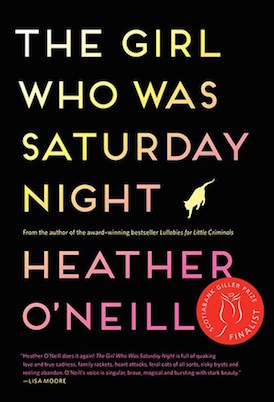
This week I finished Heather O’Neill’s 2014 novel “The Girl Who Was Saturday Night,” which was discussed at our book club. It’s about a brother and sister who are 19-year-old twins, navigating the mean streets of Montreal in 1995. They were raised by their decrepit grandfather since their young mother left and their father, a famous folksinger, wasn’t around much. Hence the Tremblay twins are both a bit hellions with no money to spare. The girl is trying to straighten her life out (she finds love, marriage, and is taking classes to go to university), while the boy is sliding into more trouble. It’s the time of Quebec’s 1995 referendum, which asked voters whether the province should proclaim its national sovereignty and separate from Canada. The twins and their relatives are all in favor of Quebec’s separation, but when the vote loses by a minuscule margin, it seems at the same time there are consequences in all the characters’ lives.
I thought “The Girl Who Was Saturday Night” was quite a wonderful novel, vibrantly told from the twin sister’s point of view. I read its 403 pages quickly in three days. It’s compulsively readable, and as my friend in the book club said, its story “gets under your skin.” It seems to paint Montreal at the time to the core. Set among the poor and grubby, the twins are trying to find themselves and pave their ways. It’s a coming-of-age story that is a bit of a different take. I found it to be darkly funny with some terrific sentences that I wanted to underline throughout. However a few in our book club said they didn’t care for the author’s writing style. For one thing, she uses an overabundance of similes (as well as metaphors and cats) to get her descriptions across, which can get a bit taxing along the way, but despite that I thought her writing on the whole to be lively, fresh, and noteworthy. I don’t know much about Montreal but definitely got an interesting flavor for it in this homage to the author’s home city.
I’m quite certain the novel will make the short list for the Baileys Women’s Prize for Fiction (formerly the Orange Prize) when it’s announced this Monday. So far there are 20 books on the long list, which will be cut to 6 books for the short list. From those, the winner will be announced on June 3. I’d be very surprised if “The Girl Who Was Saturday Night” doesn’t make the cut on Monday. If I were a gambler, I’d bet on it, but what do I know?
How about you — have you read this novel or author before? If so, what did you think? Or what are you up to or reading this Sunday? Continue reading
Posted in Books
16 Comments
Neverhome
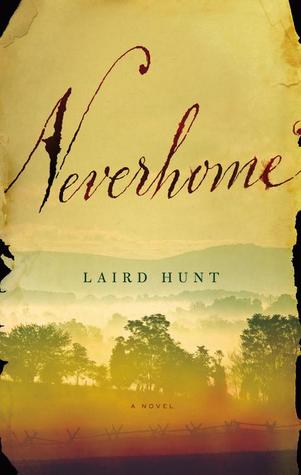
Laird Hunt’s acclaimed 2014 novel “Neverhome” starts off simple enough. It’s narrated by a housewife and farmer named Constance from Indiana, who in 1862 decides to disguise herself as a man to enlist in the Union Army. She takes the name Ash Thompson and leaves behind her meek husband, Bartholomew, to care for the farm. The story follows her journey as she endures soldier life and harrowing battles of the war while trying not to be found out as a woman.
The novel’s prose is simple and stark but rich in its descriptions, especially of the battle scenes, and the syntax takes on the vernacular of the times, which seems a bit awkward at first, but gives a vivid feeling of being in the Civil War era and its settings.
The character Ash proves to be an excellent shot and sure fighter. She seems heroic and able to outmaneuver and shoot her way out of trouble. But there’s also baggage from her past that comes to her in dreams: her mother’s death haunts her, as well as the death, we learn in time, of her newborn son. There’s also letters from Bartholomew hoping for her return and fearing that she will not.
Along the way, Ash witnesses horrific bloodshed and is injured in battle. A nurse heals her, only later to give her over to authorities who chain her up in a prison, where she’s abused. The book is a bit of a page-turner as you wonder whether Ash will make it back home alive and what unfinished business will be awaiting for her once she gets there.
At first glimpse “Neverhome” appears to be a straightforward heroic story about a strong woman who overcomes great odds but not too far into it you become aware that Ash is carrying around secrets, which she doles out only here and there, and is talking to ghosts. Amid the war, her mind starts to unravel, too, and what is real or not real becomes hazy. She seems to undergo a transformation, and you have to wonder whether she’s telling the truth. The dark ending brings everything home, so to speak.
Judging by comments on Goodreads, quite a few readers thought the story’s ending went off the deep end, or they didn’t get it. I was one of those who had to reread it a few times to understand what it all suggested. I think I was lulled into the story going a certain way, and then it took a turn quite other than that, which left me a bit puzzled and not pleased. Ash is a character who definitely is more complex than she seems. Though I might not have wanted the story to go in that direction, I thought the novel’s writing was quite visual and beautiful in places. For a slim book, “Neverhome” wields a large takeaway.
It also makes me want to read more books about the Civil War, including last year’s nonfiction book by Karen Abbott called “Liar, Temptress, Soldier Spy: Four Women Undercover in the Civil War.”
How about you — have you read “Neverhome” and if so what did you think? Or what books set in the Civil War era are your favorites? Continue reading
Posted in Books
6 Comments
Dark Rooms
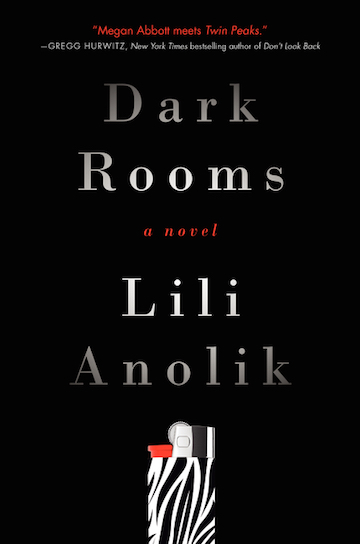
I picked up Lili Anolik’s debut novel “Dark Rooms” at the library for a quick suspense read, a transition after a couple of denser books. I didn’t really know anything about it other than it appeared to be among the popular genre of crime novels set at private high schools. The publisher touted it as Donna Tartt’s “The Secret History” meets Gillian Flynn’s “Sharp Objects” with twists of Megan Abbott’s “Dare Me” along the way. Okay, okay, I think I get the picture?! I snapped it up and read it quickly this past week ready for something a little berserk.
“Dark Rooms” takes place at a private high school in Hartford, Connecticut, where one morning student Nica Baker, age 16, is found murdered in a nearby field. Her parents, both teachers at the school, and older sister Grace, who recently graduated, are grief-stricken and foggy amid the media circus that follows. The police though are able to close the case quickly when a student commits suicide a couple weeks later, leaving what appears to be a confessional note to the crime. Grace though begins to have her doubts about it. She puts college on hold, stays at home, and becomes obsessed with finding out the truth about her sister’s murder. Though in the process, she opens a can full of worms about her family, herself, and those who knew her sister.
Nica, it turns out, was no angel; she was beautiful and also promiscuous — different than Grace, who sets out to tackle a long list of Nica’s admirers to find out what really happened. Meanwhile Grace finds herself pregnant after a drunken grief-laden escapade and with little time left to solve the murder. Oh my. One thing’s for sure: There’s considerable sleeping around going on at this high school: among the faculty, the kids, you name it. It’s a high school on hormones. The so-called adults or parents in the book aren’t exactly role models either; a few are downright creepy, so Grace must make her away through some pretty messed up, disturbing stuff to find out the truth. She’s a Nancy Drew of sorts. I can’t say much more though I’m sure I’d like to.
Admittedly the book held me till the very end. The author did a good job painting the scenes, giving vivid details, and moving the story along. It’s the kind of suspense story I was looking for when I picked it up. It’s done well, both the writing and plot as well as the twists kept me guessing, although there were a couple times I had to suspend my disbelief and I’m still wondering if the ending fizzled just a bit. Still if you’re on a flight from L.A. to New York, or even on a beach this summer, I’d say this is a suspenseful, well-done novel to hold your attention and pass your time with. Who knows, it might even make you a bit more grateful for the folks and family you have.
How about you — have you read “Dark Rooms” and if so, what did you think? Or what if any are your favorites in the genre of high school/crime novels?
Posted in Books
10 Comments