
-
Follow me on:
-
Category Archives: Books
The Wettest County in the World
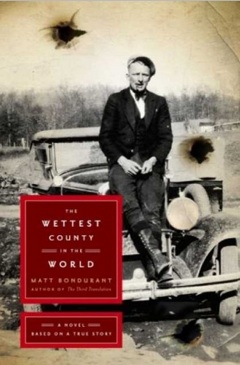
I’ve been up to my ears in moonshine so to speak. I just finished Matt Bondurant’s 2008 historical novel “The Wettest County in the World” about the bootlegging that went on in Franklin County Virginia during Prohibition and then I saw the new movie adapted from it called “Lawless.”
Although the movie is decent, the book, as usual, is far superior. It’s a story about three brothers (actually the author’s own grandfather and great-uncles) who illegally ran moonshine stills and distributed “white lightning” under the cover of their filling station. It was apart of the ’20s and early ’30s when moonshine activity exploded in the poor Virginia county amid the Blue Ridge foothills. “The Bondurant Boys,” as they were known, were like many of the residents there involved in the illegal liquor trade. The Bondurants came up against law officers who covertly demanded their cut of the bootlegging profits. What happened in real life was a bloody showdown.
“Wettest County” is a novel based on that true story, which the author pieced together from news articles and filled in the gaps with his imagination. His grandfather never talked about his moonshine involvement other than to confirm he had once been shot. The rest the author dug up and turned into a vivid and resonant account.
The descriptions and atmosphere are right out of Prohibition- and Depression-era times. It’s direct and often violent, comparable to some of Cormac McCarthy’s writings but perhaps with more hope and less darkness. The brothers overcome various harsh realities, including the early loss of their mother and two sisters in the flu epidemic, and the night the head brother, Forrest, is left for dead with his throat cut open by two rival goons.
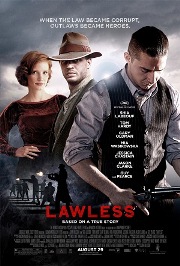
The story is exceptional and well written, but the novel isn’t totally easy. Most of it’s from Jack, the youngest brother’s point of view, but one thread conjures Sherwood Anderson, the author, who covered the resulting bootlegging trial. It jumps in time back and forth from 1935 to earlier. It gets a bit confusing or distracting a few times and I lost some steam in my reading about half way through, wishing parts might be a bit shorter. But still I took away from it an interesting dose of moonshine history and a story forever etched in my memory. I’d be interested to check out Matt Bondurant’s latest novel “The Night Swimmer” as he seems quite a writer to watch.
As for the movie “Lawless,” prepare yourself for some uncomfortable violence. For me, the screenplay was missing some of the essence of the novel. It’s too bad because the cast is quite good, albeit the foothill dialect meandered a bit. It’s still pretty decent and might not be too far off from other such attempts at novels like “All the Pretty Horses” or “Cold Mountain” that were moved to the silver screen. Lyrical books are just hard to match in movieland. Continue reading
Posted in Books
4 Comments
Surfacing
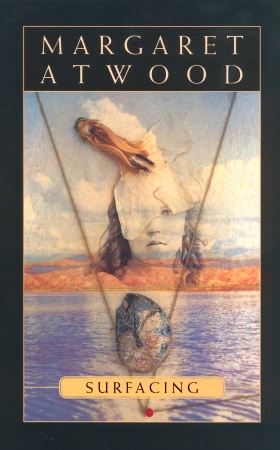
Margaret Atwood’s “Surfacing” is a bit of a creepy little novel about a woman who returns to her hometown in Quebec to look for her missing father. She brings her boyfriend along and a married couple who accompany her to her family’s old cabin on a remote, woodsy island. But with her father disappeared and her mother deceased, all that’s there are her childhood memories, which seem to overtake her. It’s while she’s staying on the island to look for him that her mind begins to unravel.
Check out the book’s cover; doesn’t it make you feel a bit uneasy? In that respect, it slightly reminded me of Dennis Lehane’s “Shutter Island” from 2003. But “Surfacing” was published 40 years ago in 1972, and has a lot of themes going on in it from that era, particularly Quebec’s separatist movement, Canadian nationalism, feminism, and environmentalism. The main character feels alienated by social pressures that she play a particular role because of her gender – which makes her respond by withdrawing.
“Surfacing” feels like it’s from the late ’60s – the four characters are hippy-ish — but still the novel seems quite potent today. Partly that’s because Margaret Atwood is a master who doesn’t mess around getting her themes across, but also it’s because these themes still linger. I had to grin a bit when the character David wants to drive the “fascist pig Yanks” out of Canada. The American “infiltration” up North is still a real sore point among quite a few.
I liked the novel as I felt as if I were on the island with the four characters – one of which is a chauvinist jerk — and there’s an ominous feeling that something eerie is going to happen. It’s quite tangible but towards the end, I did have to read some passages a few times over to make sense of what is going on. It gets quite loopy and is not totally easy to understand in places. But the writing is quite lyrical and otherworldly.
This is my third novel that I’ve read by Margaret Atwood, who I think is such a unique and powerful writer. “Alias Grace” is perhaps my favorite, but this one isn’t shabby either. I plan to keep reading Atwood and other Canadian authors because I live in Canada now – and want to familiarize myself with the great fiction of this vast and wonderful country. Continue reading
Posted in Books
4 Comments
Wild
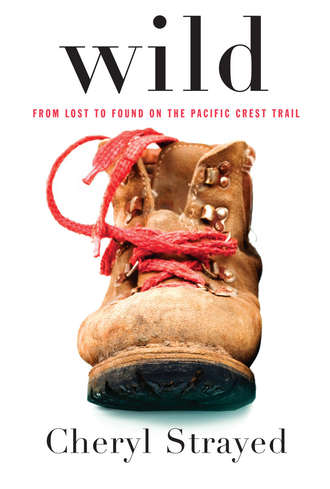
I made this trek and I’m glad that I did. Not the Pacific Crest Trail that Cheryl Strayed hiked 1,100 miles from the Mojave Desert through Oregon doing but her memoir about her long walk in the summer of ’95. There’s plenty in “Wild” that might rile you: particularly how crazy it is to attempt such a journey so ill-prepared and by yourself at age 26. Wouldn’t you practice or get in shape first? Take a test-run, a buddy, and enough money? Know what you’re doing? I had to roll my eyes at the beginning: it seemed pretty dumb if not totally dangerous. She is in agony most of the time from boots that don’t fit and toenails that fall off and pockets short of coin.
But people that are lost and youthful don’t always make the wisest of choices. She acknowledges her “idiocy” at the journey’s beginning. But before going, Cheryl had been dealt a heavy blow with her mom dying at 45 of cancer that left her reeling. Her siblings scattered as did her stepfather. She was using drugs, fooling around on a husband she cared about and going nowhere under a heavy maze of grief. After seeing a book about the Pacific Crest Trail (which goes from Mexico to Canada), she gets the idea to hike a good portion of it in hopes that it will turn her life around. And so her journey begins.
Admittedly, I’m a bit of a sucker for healing-seeking, journey-type stories and devoured Jon Krakauer’s “Into the Wild” about a 24-year-old’s attempt to live in the wilds of Alaska. Fortunately, Cheryl’s trek has a much happier outcome. The trail works its magic on her through all the pain, endless miles and solitude of walking in the wilderness alone. She does befriend quite a few fellow PCT hikers along the way and has various adventures, coming upon rattle snakes, bears, a migration of frogs, and non-PCT folks who are most often a bit weird but friendly.
Cheryl tells of her trek rather open and straightforwardly, often unsparingly of herself. “Wild” is not as gripping as Krakauer’s books, but it did keep me reading and thinking about it, as if I were traveling alongside her on the trail. I felt for Cheryl over the sadness of her divorce and mostly her mother’s death, which is palpable and enormous in the book. I wanted her to find solace. And indeed she seems to grow stronger and more courageous as she moves forward along the PCT.
There’s some good passages in the book, a few profound about her life growing up and her mother and family and being on the trail day and night and the hardships life throws you. I might not always agree with her choices but she comes across most often heartfelt, likable and a bit irreverent.
One thing that sort of made me hesitate about “Wild” is that it was published over 15 years after she did the trail, apparently from journals and such. Maybe that holds back some of the vividness or action in parts of the book. It’s a bit amazing she can piece together all of the conversations from back then. But despite whatever flaws, “Wild” still hits a human chord that leaves a pretty deep impression. And it might just leave you wanting to do the PCT yourself. Continue reading
Posted in Books
5 Comments
Once Upon a River
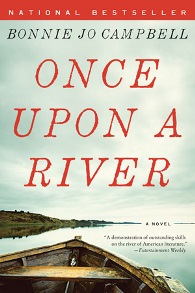
I first heard about Bonnie Jo Campbell’s “Once Upon a River” from Washington Post book critic Ron Charles, who put it on his best of 2011 list. And now I know why. I was thoroughly absorbed by this novel set in the early 1980s about a 16-year-old girl who, after her mother splits and her father’s violent death, takes to the river of her rural Michigan town in a rowboat to try and find her mom and in the process begins to forge a new life.
Rural, impoverished river life is not exactly the safest place for a pretty girl, and she happens upon some unsavory characters along the way. Luckily Margo Crane is no ordinary girl; she’s quite the survivalist, who can shoot like a sharpshooter (Annie Oakley is her hero), skin and cook wild game and fish, and sleep for weeks in the great outdoors. She’s a throwback, who prefers being in the natural world on the river with her gun and a dog to school or what other kids are into it.
It’s a rough existence though, and impending hardships and violence seem to lurk around each bend. You might slightly think of the river adventures of Huck Finn crossed with those of “Deliverance” perhaps. But Margo Crane also reminds me of one of those great female characters like the tomboyish Scout in “To Kill a Mocking Bird.” She’s that good and able.
Best of all, is author Bonnie Jo Campbell’s writing, which so seamlessly conjures the natural world of the area and sucks one into the story before you know it. It flows so naturally like the river, and I was turning pages pretty lickety-split to find out what happens to Margo. Will she find peace and a home on the river? Will she go back to her mother? Will she find a way to live that she so desires? These are some of the quandaries that are partly resolved at the end.
“Once Upon a River” is a pretty hypnotic read. It might not be for everyone due to some violence or its backwoods environment and cast, where hunting and skinning wild game is a means to get by, but I would have to say it’s my favorite read so far in 2012. Bonnie Jo Campbell is a writer to watch; she’s already been a National Book Award finalist with her short story collection “American Salvage,” which I intend to read in the future, or anything else she happens to write next. Continue reading
Posted in Books
4 Comments
The Chaperone
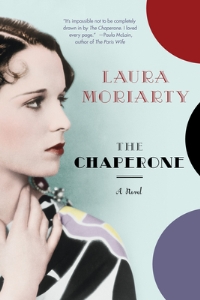
“The Chaperone” by Laura Moriarty was a favorite of book bloggers when it came out in June. It’s my first audiobook I listened to without being on a road trip. Instead I listened to it while either out walking or gardening in my yard, which I found quite enjoyable, though it took me a few weeks to get through the 9½ hour or so audio.
Many know by now the novel’s about a 36-year-old woman named Cora Carlisle who chaperones a precocious 15-year-old Louise Brooks from Wichita, Kansas, to New York City in 1922 to attend a prestigious dance school. The housewife Cora is quite the traditional, corset-wearing lady of the times, whereas Louise is oppositely unconventional and misbehaved. Their relationship while in NYC is challenging at best, but what happens to each during the summer of 1922 alters the course of their lives. Louise goes on to become a silent-film star of the era, and Cora, through a variety of circumstances, becomes more open and liberated in life, aiding single mothers, for one, and endorsing contraception.
At first, I wasn’t sure if the story was for me because the characters and times it depicts start off so prim and proper and repressed. The moral values are pretty heavy-handed, and the story seems quite pat and tidy. But as I kept listening, it picked up and spread its wings so to speak. I was amazed by the fine storytelling and the breadth of the novel, how it tells of Cora’s and Louise’s lives through the backdrop of history, of orphan trains and Prohibition times, and the details of what people wore and thought. It covers a lot of ground. Cora is well into her 90s by the end. I felt like I knew her and that her story was real and that I would miss her. It’s a bit crazy to think, but it grew on me as both Cora and Louise came to life.
Perhaps it was also Elizabeth McGovern’s fine narration of the novel that won me over. No wonder she’s in the excellent “Downton Abbey” TV series. She engulfs the roles in “The Chaperone.” Maybe she’s a natural throwback to the early twentieth century.
But dumbly it was not till after the audio that I found out that Louise Brooks was indeed a real person and silent-film star of the era. Author Laura Moriarty cleverly uses that one real summer accompanied by a chaperone in 1922 to create a fictional account of Cora and her life alongside the real Louise and that of history. Louise and Cora might not have ended up as true deep friends, but they did benefit from one another, and the story of their lives is touching. Continue reading
Posted in Books
3 Comments
Gold
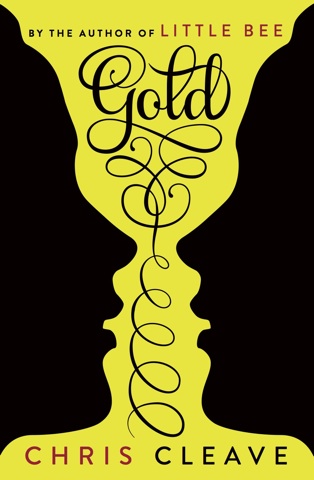
Oh the emotional tugs of a Chris Cleave novel! Beware of kids who are either seriously ill as in “Gold,” or making their way to a new country as in “Little Bee,” or blown up as in “Incendiary.” Usually victims and survivors populate Cleave’s novels and those who discover the very marrow of their lives in desperate, terrible situations.
His earlier novels “Incendiary” and “Little Bee” were riveting storytelling, maybe each had parts of suspended disbelief, but still you clawed your way through them at a rapid pace. His latest novel “Gold” is that way as well, but for me gets the “bronze” compared to his others.
“Gold’s” release is timely as the London 2012 Olympics are about to begin next week. The story is about two female world-class track cyclists who have been teammates, friends and rivals since they were 19, and now that they are 32 they are nearing the competition of their last Olympic Games. Who win the one coveted team spot to go? And what will they sacrifice to get there?
Cleave seems to dangle these till the very end, with Kate the kind, loyal, mother-figure who has missed two prior Olympics pitted against Zoe, the harsh, solitary model-looking gold medalist who will do anything to win. (Even it means sleeping with Kate’s boyfriend and future husband, Jack, a gold medal cyclist himself.)
The Kate-Zoe and Jack triangle spins around, interspersing with narration from Kate and Jack’s sick daughter Sophie, who has leukemia and is obsessed with “Star Wars,” and from Tom Voss, Kate and Zoe’s old, crotchety coach, who missed the ’68 Olympics and has demons of his own.
Everyone is a bit emotionally wounded here (as typical in a Cleave novel), but in this one, world class physical fitness contrasts with the frailties and sickness of a child and the decrepit body of old age. Going for the gold takes on a whole different meaning here, where life and death, family and human bonds are all at risk.
Cleave’s storytelling and dialogue are typically alluring. I thought “Gold” would be the perfect summer fast-read, and it was pretty good in visualizing the rivalry and their velodrome sporting worlds, but it was flat in parts and didn’t exactly rise to the level of his others. The character Zoe is pretty maddening along the way, you want to shake some sense into her and perhaps the rest of them too. The secretness of the scandal toward the end is a bit hard to believe, and the story sort of hits you over the head with its cast and message. I was glad to go for Cleave’s “Gold,” but I just didn’t (overly) love it. Continue reading
Posted in Books
3 Comments
B.C. Road Trip

Greetings from Kelowna, British Columbia (Canada)! It’s a city in the southern interior of B.C. next to Okanagan Lake in the Okanagan Valley, which is known for it’s plentiful vineyards and orchards.
My husband and I arrived here after a long day driving on Friday and came for the GranFondo Kelowna 122 km bike ride on Saturday, which was invigorating and a good challenge. We were lucky because it was overcast, otherwise we would have fried like eggs on our bikes.
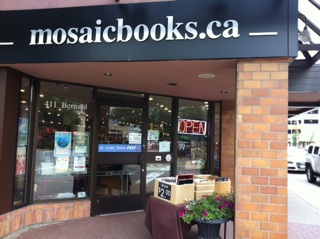
Afterwards we visited one of our favorite independent bookstores in Western Canada called Mosaic Books in downtown Kelowna. It has a big selection of books and everything is well displayed. In the back, there’s a big stock of “bargain books” where hardbacks and trade paperbacks can be bought for between $6.99 to $8.99, which is a good deal in Canada where non-used books usually cost $20s to $40s. So off we were to the races: here is my stack (below) that I bought at bargain:
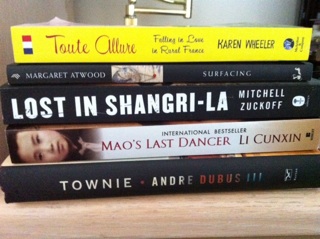
Going from the top, there’s “Toute Allure: Falling in Love in Rural France” by Karen Wheeler, which is the second book by the former British Fashion editor and writer who first wrote “Tout Sweet: Hanging Up My High Heels for a New Life in France.” This is a memoir I read before I visited France a few years ago and it proved so entertaining I had to get Part II.
The next down is Margaret Atwood’s second novel “Surfacing” from 1972. It’s about a woman who returns to her hometown in Quebec to look for her missing father. Sounds intriguing, and it’s Atwood talking about Canada after all!
Next is Mitchell Zuckoff’s “Lost in Shangri-La: A True Story of Survival, Adventure, and the Most Incredible Rescue Mission of World War II.” I heard this one is pretty amazing and was sold at Hello!
Then comes “Mao’s Last Dancer” by Cunxin Li. It’s a memoir about a dancer who grows up in Mao’s communist China and eventually defects to the U.S. I’m intrigued to read it and also thereafter to see the movie of it, which came out in 2009.
The last book in my stack is “Townie” a memoir by Andre Dubus III. Apparently the author of “House of Sand and Fog” has written a powerful account of his life — growing up in a depressed Massachusetts mill town — which I definitely plan to check out!
So all in all, five nonfiction books and one that is fiction. This is rare! Usually fiction rules my picks. Have you read any of these? And what do you think of them? Enjoy your Sunday. Continue reading
Posted in Books
6 Comments
We Only Know So Much
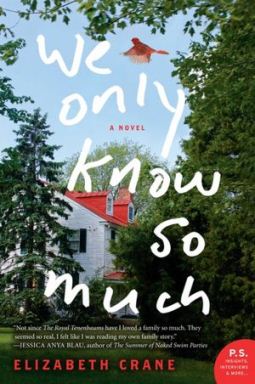
I recently found out about author Elizabeth Crane from an article by L.A. Times book critic Carolyn Kellogg. I hadn’t known her books before, which include three short story collections, but I thought I would try out her debut novel “We Only Know So Much,” which came out last month.
It’s about a family of two parents, two kids, a grandfather and a great-grandmother who all live under one roof in a small Midwestern college town. Each of the family members seems to have their own issues or preoccupations: the know-it-all father fears that he is losing his memory; the withdrawn mother is dealing with the loss of a secret lover; the difficult daughter is trying to get on reality TV; the sweet, 9-year-old son has his first girlfriend; the hazy grandfather is suffering from Parkinson’s disease; and the 98-year-old great-grandmother is fussy but loves attention.
It’s a problematic American family coming apart at the seams with an inability to communicate with one another. Each of them is going in different directions and is too caught up in their own worlds to really relate to each other. There seems to be a complete family disconnect at a critical juncture for each of them. Yet it’s a family crisis that they seem quite unaware of.
Despite this theme, “We Only Know So Much” is not really a dark novel. It’s more quirky and empathetic. The book alternates chapters among the family members so you get a gist of all of them. But some are more fleshed out and better than others; the grandfather and great-grandmother seem less realized, and I thought the bitchy daughter perhaps the most developed and enjoyable.
The novel has well-done moments, but I can’t say it was a novel for me. Despite the entertaining way Crane writes, I thought the first half of the novel pretty slow. The family members’ issues are introduced and then their problems are just gone over again. There’s little change or development or much that happens. Towards the end, a few of the strands in it thankfully pick up. But at times it seemed more a portrait of a family than a story where something actually develops or happens. I’m not sure I really liked the characters, but I made myself not quit on the book and came away with a quirky picture of a family rather run amuck.
For another perspective, some over at Goodreads liked it much better than I did. I guess it’s a matter of different strokes for different folks. Continue reading
Posted in Books
3 Comments
Too Much Happiness
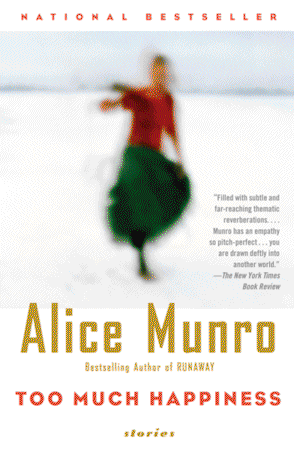
Shortly after marrying a Canadian and becoming a Canadian resident, my sister-in-law thrust a book into my hands by Alice Munro, one of her favorite authors. I had known about Munro, the acclaimed Canadian writer who had won many awards for her short stories (including the 2009 Man Booker International Prize), but I am embarrassed to say before now I had not read any of her collections. Her stories were often in the New Yorker and I might have read her there, but I knew living in Canada that her books would be essential reading for my own cultural introduction to my new country.
Her short-story collection “Too Much Happiness, ” which is her most recent from 2009, didn’t disappoint but rather exceeded my expectations from the praise that preceded her. I guess I don’t often read short stories (though I have liked Raymond Carver’s, Jhumpa Lahiri’s and Somerset Maugham’s) but delving into hers were easy and absorbing, like falling into a world that sweeps you up. I was a bit surprised that this genteel author (78 years old at the time) from rural Ontario wrote about characters that drew you in so completely to such ominous or unsettling predicaments. Murderers, deviants and misfits pepper the stories of “Too Much Happiness,” which reminded me a bit of the dark aspects of Flannery O’Connor’s or Joyce Carol Oates’s stories.
In “Child’s Play,” two summer camp friends live with the repercussions of a terrible crime they commit, while in “Face,” a boy deals with the taunts from a birthmark that covers half his head. In “Deep-Holes” a family loses touch with a son involved in a cliff-falling accident, and in “Free Radicals,” an old woman saves her neck by telling a violent burglar of her own past crime. All 10 stories in “Too Much Happiness” are quite affecting; they grab at your lapels and shake you good. But perhaps the creepy “Dimensions” and “Wenlock Edge” are the collection’s most unnerving. It’s in “Dimensions” that an incident jars a wife to finally overcome her ties to her abusive jailed husband, and in “Wenlock Edge” where a student’s sexual violation steers her to turn in another.
It’s hard not to give too much away, better just to marvel at Munro’s mastery of these potent stories. Interestingly, her last story, “Too Much Happiness,” is quite a departure from the others. It’s based on a real person Sophia Kovalevsky, who was a prominent Russian mathematician in the latter 1800s, and deals with her life in the days before her death. Though interesting, I thought the other more contemporary, Canada-set stories pulled at me more. But regardless, I’m going to add Munro’s other collections to my reading list, particularly “Runaway” from 2004 and “The View From Castle Rock” from 2006. She’s definitely a writer to be treasured and one I’m so glad, no matter which side of the border, not to have missed. Continue reading
Posted in Books
2 Comments
Bring Up the Bodies
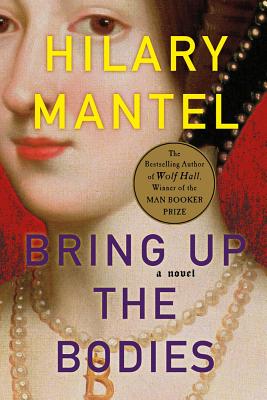
I coincidentally was reading Hilary Mantel’s historical novel “Bring Up the Bodies” around the same time as I was watching the “Diamond Jubilee” celebration, commemorating Queen Elizabeth II’s amazing 60 years on the throne of England. Perhaps there’s not a direct correlation, but I’m definitely getting my fix of English royal history lately, with its influential monarchs and their reigns of power, accomplishments, struggles and scandals. It’s fascinating material to be sure.
Mantel’s latest novel about Thomas Cromwell, the court of King Henry VIII and the destruction of Queen Anne Boleyn has received unanimous gushing reviews as did her previous book of their earlier years, “Wolf Hall,” which was awarded the 2009 Man Booker Prize. The print critics love her, with Janet Maslin of the New York Times going as far to say that “Bring Up the Bodies” is “this year’s best beach read” and the “one must-read of the season.”
Best beach read? Hmm, I had to read it. But now that I’m done, I can tell you, if you like “War and Peace” or Shakespeare on the beach then perhaps you will definitely like this one. Otherwise, I’d stick to something lighter and easier to sink into. “Bodies” definitely has the elements of a beach book, with power plays, intrigue, rumors, gossip, revenge, adultery, violence, but it swirls around for quite a while, muting its impact. Its narrative language though beautiful by Mantel is a bit of a challenge for the beach; it’s not Olde English but it’s not exactly contemporary either. You’ll have to work a bit to get the array of characters and who is speaking when and what is being said. At times it can be a bit confusing or even a slog to read, but I did successfully plow through it and came away with a more vivid picture of the poisonous atmosphere at the court during Anne Boleyn’s last months.
You don’t have to read its predecessor “Wolf Hall” to understand “Bring Up the Bodies”; I went right to the latter one, which is meant to be the second in a trilogy — all told from Thomas Cromwell’s point of view. Cromwell was King Henry VIII’s right hand man, his secretary and power broker, who comes to believe he must destroy the Queen before she destroys him. Mantel paints him as more human than just ruthlessly evil, which is how he is often portrayed, though he’s still cleverly shrewd and harsh in the end.
The book takes place over nine months from 1535 to 1536. As it begins, Queen Anne Boleyn has replaced King Henry VIII’s first wife Katharine of Aragon with much ado, leading the King to break with the Catholic Church in Rome. All is momentarily at peace. But after three years, the king grows restless as Anne is unable to produce a male heir and he begins to favor Jane Seymour. Thereafter the Queen’s days are numbered. Cromwell uncovers a web, eventually arresting her along with five men on trumped up charges of adultery and incest (with her brother). Whether she is actually guilty as charged is a mystery preserved in the book, though it sides with it being unlikely. In an interview, Hilary Mantel has said the Queen gives the impression of being guilty, whether or not she really is, is not known.
Surely the book is quite dark; everybody’s out for themselves and trying to gain their advantage with the King and the court. It seems Machiavellian. Some have sympathies with the last Queen, while others are aligning with the future, Jane Seymour. The plot gangs up on Anne Boleyn, and it is quite chilling to read about a woman’s place then and the abuse of the court’s power — all because Henry VIII wanted a new wife. There’s not really a redeeming character in the book to latch onto, and despite what it’s about, not a lot of action. I was hoping for more. It’s mostly filled with the verbal sparring, court gossip and posturing amid its unseemingly cast. I took away quite a bit from it but not without considerable persistence and effort — something that I don’t hope for in my next (real) beach read. Continue reading
Posted in Books
9 Comments