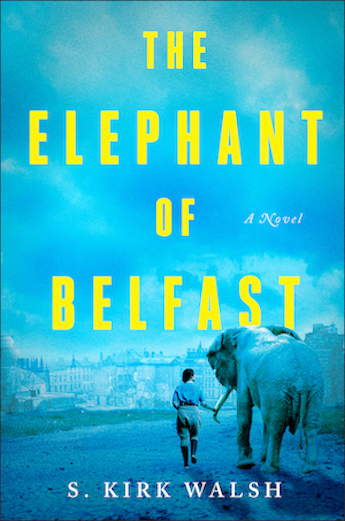
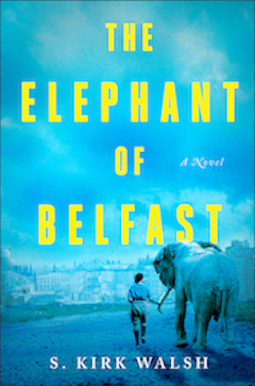
Hi. I hope everyone had a great week. It’s been surprisingly hot here. I’m very excited this week to post a Q & A with author S. Kirk Walsh whose debut novel The Elephant of Belfast came out in April and I reviewed last week. Have you ever wanted to know the details behind the story of a great read? I find especially with enticing historical fiction I’m curious beyond all heck to know more after I turn the last page. Who were these people? And did what took place really happen like that? And how did the writing of the story come together? Do you ever wonder such things? Well lately such interesting historical fiction has piqued my curiosity.
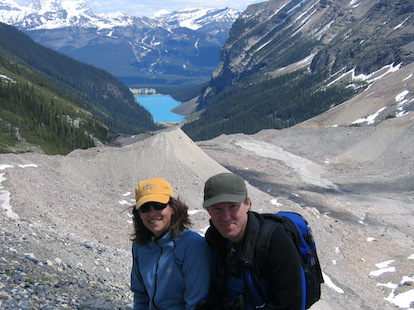
And as my review last week mentioned: The Elephant of Belfast is a story about a female zookeeper (Hettie) in Belfast, Northern Ireland, during WWII … whose home life has been tough and who comes to care for a three-year-old elephant (Violet) at the zoo. It’s about what happens to them when the Germans begin to bomb the city in 1941. It’s a wonderful, evocative story inspired by true-life events. I was quite taken with it, so I reached out to the author and she very kindly answered my questions and is letting our Q & A be posted here. (It doesn’t ruin the story.) I hope you find her novel and answers as fascinating as I do. She supplied the wonderful photographs.
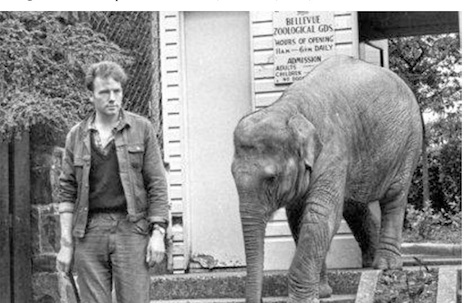
1) Can you tell me about how you found out about this real-life Irish female zookeeper who worked at the Belfast Zoo during the Luftwaffe bombing raids of WWII? And how much time you spent in Belfast researching parts of the story? It seems like you knew the city of Belfast well.
Walsh: My novel was inspired by Denise Austin, the first female zookeeper at the Belfast Zoo. I heard about her story on the radio in 2009 after her identity had been discovered by the zoo. After hearing the story of Denise and her young elephant charge named Sheila, I thought the idea might make for a good novel.
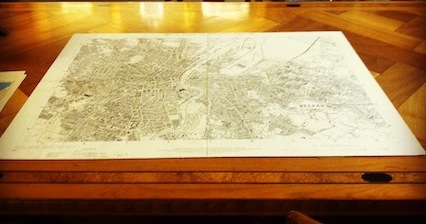
A few years later, in the summer of 2013, my husband and I spent about two weeks in Belfast. There, I interviewed zookeepers, historians, and survivors of the Belfast Blitz. Once I returned home, I did more research at the New York Public Library, where one can find maps of Belfast from the 1930s, wartime photography taken by The Belfast Telegraph, and microfilms of the Mass Observation Archive (which focuses more on the day-to-day life of wartime Britain).
The scholar/historian Brian Barton—author of the definitive history of the Blitz titled The Belfast Blitz: The City in the War Years—also provided a lot of guidance and read the manuscript a few times for historical accuracy.
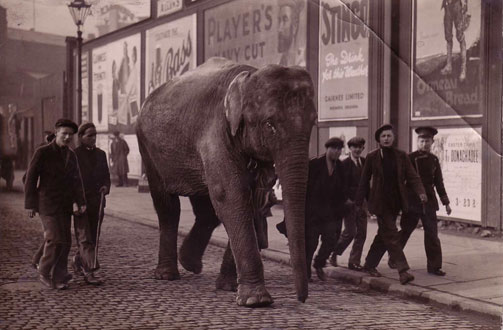
2) Also can you tell me about what the real zookeeper was like and how long she lived? Is she credited with saving the elephant? And did she really have to relocate the elephant during the bombings in WWII?
Walsh: Similar to my protagonist, Denise Austin was about twenty years old when the Germans bombed Belfast. She lived with her parents on the Whitewell Road. During the evenings leading up to the bombings, Denise walked Sheila to her home and then returned the three-year-old elephant to the zoo during the day (following the Crazy Path, as described in the novel). The zoo staff didn’t know about these activities until the elephant chased a dog one day and damaged a neighbor’s fence and property. “That was the end of the elephant taking a holiday every night,” David Ramsey, Denise’s cousin, explained to me when I met him in Belfast. Instead, Denise stayed with Sheila in her enclosure at the zoo during the bombings (a little different from my fictional retelling). It’s unclear how big of a role Denise played in saving Sheila’s life.
After the war and her employment at the zoo, Denise went on to become a nurse with the Army and then traveled widely (mostly on international cruises). Ramsey described Denise as having “a great laugh.” She never married; her boyfriend drowned on the Princess Victoria ship when the ferry sank during a windstorm in the North Sea on January 31st, 1953. Austin died in 1997.
3) Were the German bombing raids extensive in Belfast?
Walsh: There were three nights of bombings in Belfast: April 7th, April 15th, and May 4th. The Easter Tuesday raids depicted in my novel reflect what happened during these aerial attacks; many of the details are borrowed from the survivors who I interviewed for the novel. I decided not to include the May 4th bombings (The Fire Raid) because I couldn’t put my characters through more devastation.
In addition to the interviews with the Belfast Blitz survivors, I drew from my own experience of living in Manhattan during the terrorist attacks of September 11th.
4) In the story, Hettie seems to be a very forgiving person — first with Samuel Greene and his actions and then with her brother-in-law Liam’s actions. Why do you think Hettie is like this?
Walsh: In a way, her father, Thomas, prepares Hettie for this kind of forgiveness. He is a father who has loved her, but hasn’t been present in her life in a consistent matter. Hettie is young, but by the end of the novel, she discovers an unexpected maturity due to the devastation and loss. As a twenty-year-old, I made a lot of mistakes and missteps, and it was only when I was a bit older that I could see my own flaws but also forgive the behavior of others around me. Hettie perhaps experiences this in a more compressed manner because trauma and crisis often accelerates growth and understanding.
5) The way you wrote about Violet and her bond with Hettie made it seem like you understand animals’ sensibilities and their specialness … Are you an animal person? Did that part draw you to write the story? And how much research into elephants did you do? The elephant Violet is just wonderfully portrayed in the book.
Walsh: I am an animal person. I grew up with cats and dogs, and they were important to me. That said, I was more drawn to the location of the novel (Northern Ireland) than the animal (Sheila the elephant). My dad’s side of the family comes from Ireland, and I knew that I would write something set there, but didn’t realize that I would end up writing about the North.
For the elephant research, I paid several visits to the Houston Zoo. They have a large family of Asian elephants, and at the time of my visits (late 2013), two of the elephants were three years old (the age of the elephant in the novel). I was very fortunate that the zoo allowed me to wash one of the young elephants (named Tupelo). I did write an essay for Texas Monthly about my research at the Houston Zoo: Readers can read it here.
6) Were you aware of or had you read Diane Ackerman’s book The Zookeeper’s Wife, which takes place in Poland? It’s quite a different story (about hiding people during the war) … but it is also an interesting look at a zoo during wartime and some of the animals.
Walsh: Yes, I’m aware of Ackerman’s novel, but I didn’t read it because I didn’t want to be influenced by her story. There are several World War II novels that I haven’t read yet: All the Light We Cannot See by Anthony Doerr, Life After Life by Kate Atkinson, and others, which I hope to read at some point in the future.
7) How long did the novel take to write? And are you working on another novel now? If so, will your next one be historical fiction?
Walsh: It took me about six years to write and research The Elephant of Belfast. I wrote about sixteen drafts of the manuscript. It took a long time to develop the emotional narrative arc of Hettie and Violet even though I already knew a great deal about their story. I’m working on a new novel about Detroit, Michigan, during World War II. Same time period, different location, and a different set of complications and tensions. It’s tentatively titled Detroit Days.
And that’s a wrap for the Q & A. Wow, thanks so much to S. Kirk Walsh for all her wonderful info and photos and letting us in on the writing and research of her terrific debut novel The Elephant of Belfast. I hope many get to read it. In learning more about it, I was amazed by how much the novel followed what actually happened there in 1940-41 and brought it to life.
Let me know what you think of the Q & A … as I might try to do more in the future. Have a great week everyone.