
Hi. How is everyone doing? I think it’s been about a month now that lockdown life started. It was the week around St. Patrick’s Day that things really began shutting down quickly. My husband and I have adjusted fairly well — sheltering in place — and luckily he still has his job and is able to work from home. My part-time work officiating provincial and national tennis tournaments has been wiped out, but the organization is still meeting online once a week to see where we go from here. It’s hard to imagine how many nonprofits and small businesses are going to be able to survive the pandemic … and not without much financial help I think. I hear that some areas are thinking about “opening up” the economy and easing restrictions soon … but will it work … or is it too soon? What do you think for your area?
At least the weather here looks to be improving. (The photo above was taken on Easter, April 12, so we have less snow now.) And our first spring temps should hit this coming week with a forecast reaching the lows 60s, which means we’ll see a lot of snowmelt ponds and muddy conditions outside. But I look forward to seeing my yard … and getting back out there, prepping the garden and cleaning it up from last fall. Can’t wait for spring here! Meanwhile I’ll leave you with a couple reviews of what I finished lately.
Sweetbitter by Stephanie Danler / Knopf (first edition) / 368 pages / 2016
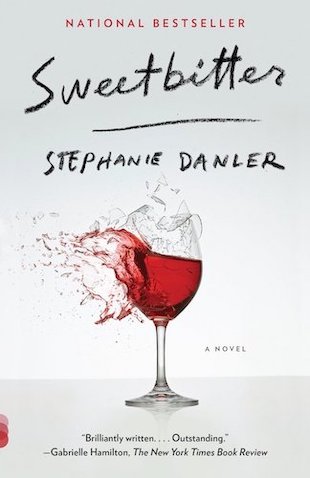
Synopsis: It’s a coming-of-age novel about 22-year-old Tess who’s newly arrived in New York City and lands a job as a server at an upscale Manhattan restaurant. There, she learns her way … thanks to the staff friends she meets, experiencing a lot about life in the City, punishing work, food and wine, friendships, love, and drugs.
My Thoughts: Oh yes, what’s it like to be a young adult — inquisitive, working hard to earn a living, wild, free, and self-destructive again. This was a backlist read for me as Danler’s next book — a memoir called “Stray” is due out May 19 and I wanted to read this one first. I’m not sure why I didn’t read the novel when it came out in 2016. Perhaps it was because I’m not really a foodie or a restaurant connoisseur … which this one has quite a bit of … and it didn’t call out to me at the time, but it should have. Whoa. The staff friends Tess meets at the restaurant: Ariel, Sasha, and Will, not to mention Scott, Nick, Simone and Jake teach her the ways of the world, about upscale food and wine, life in the City, and the after-partying of late night restaurant work. It gradually gets pretty dark, bone-tired, and wasted: so beware, but ohh the writing!
I like coming-of-age tales and this one is a doozy … it’s a little like Jay McInerney’s “Bright Lights, Big City” mixed with Salinger’s sad Holden Caulfield and Donna Tartt’s hazy drug days in “The Goldfinch” … tossed into a salad bowl. That’s almost all you need to know … but okay, it’s also got a love triangle too that Tess gets herself involved in and keeps you guessing a bit till the end. Tess falls hard for the bartender Jake! And has trouble reigning herself in … when trouble is on the wall … but that makes it all the more hard to put down.
So yeah it’s a novel more than just about restaurant life and food — but from that setting you get a lot of atmosphere, various staff personalities, and the allure of great tastes. Tess’s restaurant mentor Simone — wise and world-traveled — is quite a beguiling character who plays a major role in testing and teaching Tess throughout. She’s hard to miss or forget in this … and Jake is well Jake — he’s alluring, a bit mysterious … and a bad boy too.
I noticed that a few criticisms of “Sweetbitter” on Goodreads said that it felt whiny and pretentious in places, but I didn’t notice that too much. It seemed pretty real to me from the author’s restaurant days in NYC, which she’s obviously based the story on. As I read on, I gradually fell into young Tess’s rabbit hole little by little and kept on trying hard to pull her out.
Such a Fun Age by Kiley Reid / Putnam / 307 pages / Dec. 31, 2019
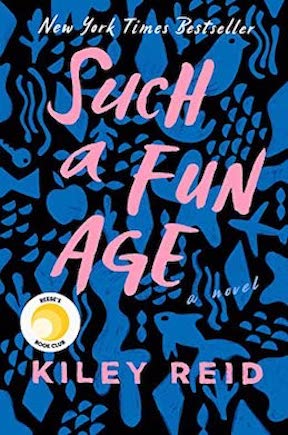
Synopsis: This debut novel, which I listened to as an audiobook, revolves around a 25-year-old black babysitter (Emira), her white privileged employer (Alix), and Kelley, a tall white man who videos an incident that Emira has at a grocery store while babysitting Alix’s daughter Briar late one night, near the novel’s beginning.
My Thoughts: There are various positive things about this novel — don’t get me wrong. The writing is active and moves the story along nicely … delving into a plot surrounding race, privilege and privacy that are worthy, interesting explorations. You also come to know the three main characters fairly well: there’s Alix Chamberlain known for her PR letter writing workshops; her black babysitter Emira, a Temple University grad who has some doubts about still babysitting after college; and Kelley, a capable techie who ends up having links to the two.
There were other things that I didn’t like as much … such as the plot relies on a couple of coincidences that are perhaps a bit hard to believe such as their ties to Kelley and how things spin out of control. Also I wanted a bit more of Emira taking care and playing with Alix’s child Briar, showing Emira’s good, endearing sides … and showing why both busy, rich Alix and Kelley are so drawn and consumed with Emira. I wasn’t as drawn to her personality as they were and wanted her to step up more and say things directly, though I felt she probably did care and like taking care of the kids.
To me all three, weren’t really that likable … though Alix does indeed come out the worst. Though I liked how the author tried making them nuanced characters (both flawed and capable) at least at first … who revolve around a situation and life that explores subtle (and not so subtle) acts of racism. It’s a theme that reminds me slightly of some of Thrity Umrigar’s novels if you’ve read them.
That’s all for now. What about you — have you read these novels — and if so what did you think? And more importantly, how are you doing?