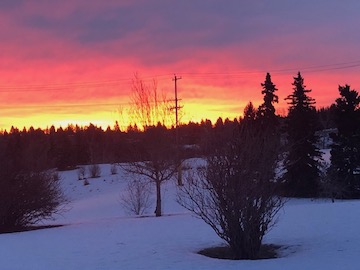
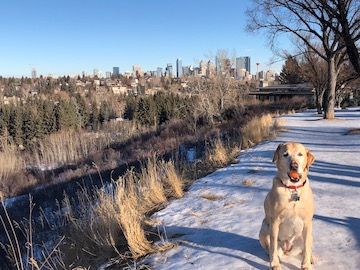
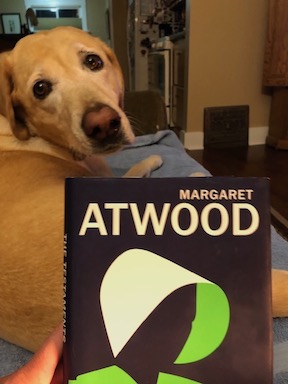
Well it’s simply too cold to go outside this week, though I have been out in brief dashes. We’re in a deep freeze up here, which apparently won’t be ending till Sunday. Good grief, I don’t even want to say what it is … but it’s around -30C / -20F. It won’t reach above 0 degrees F this week, so it’s best to bunker down. The photo of my dog and book assistant at left was actually taken in November (she never gets too cold for walks, but also likes to steal time when inside in front of the space heater). I don’t think I could take a decent photo this week as my hands would probably freeze off, but I am continuing with indoor tennis and some time at the gym along my usual chores.
I hope everyone is staying well and doesn’t have our conditions. Knock on wood. I’ll leave you with some reviews of books I completed lately. The first two are from January and the bottom three are novels I finished in December. I need to get these off my chest.
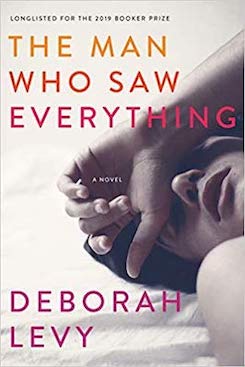
The Man Who Saw Everything by Deborah Levy / Bloomsbury / 208 pages 2019
Synopsis: In 1988, a young British historian Saul Adler, 28, who’s planning on going to the German Democratic Republic (the GDR) to do research and leave his photographer girlfriend Jennifer behind, gets grazed by a car in the crosswalk of Abbey Road, which seems to alter his life’s trajectory. Years later in 2016, Saul is hit in the same crosswalk and his memories while hospitalized return to his time in the GDR decades before.
My Thoughts: Ohh this is a sly and odd little novel, which I listened to as an audiobook performed well by British actor George Blagden. You get a picture of Saul’s life — his youth in England that wasn’t very happy with his bully brother and communist father — and his sexual life and time in the GDR getting involved with his German translator (Walter) and the man’s sister (Luna). It’s a bit interesting Saul’s stay behind the Berlin Wall and those he meets there. You get a sense of the people’s secrecy and all the surveillance by the Stasi. Jump forward to 2016 in the book’s second half, and you find out more about what happened to Saul thereafter and those he had relationships with.
I wasn’t totally sure what to make of it all — the two accidents decades apart in the crosswalks and the story’s various layers — but it seems to make some interesting parallels between Saul’s personal life and the political history then, contrasting such dynamics as East and West, feminine and masculine, past and present and life and death. It’s a story that’s thought-provoking and well written — even if it’s at times a bit bewildering. I found it quite visual amid its East and West settings and sad and with regrets.
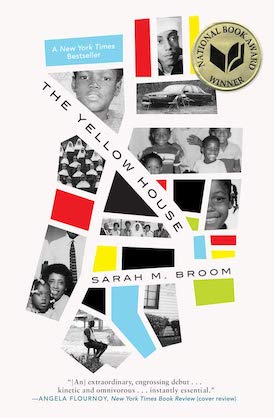
The Yellow House by Sarah M. Broom / Grove Press / 304 pages / 2019
Synopsis: The author’s debut memoir presents her family’s story (Sarah being the youngest of 12) about their lives in New Orleans East, an area far from the limelight of the city’s center, which they were uprooted from in 2005 by Hurricane Katrina.
My Thoughts: This memoir received a lot of accolades at the end of 2019, making the Best of 2019 Lists of various publications including The Washington Post and The New York Times so I was eager to get my hands on it. I found it to be many things: a memoir, a family history, and a story about Katrina and New Orleans. The first part (pre-Katrina) deals with her parents’ and family’s history and about being the youngest of 12 siblings and half-siblings, growing up in their dilapidated, crowded Yellow House in New Orleans East. Her life eventually takes her away, as she pursues college in Texas, then working for Oprah’s magazine in NYC, and a job abroad in Africa.
The second half (post-Katrina) involves the displacement of her family and so many others and the awful mess that came after the devastating hurricane. She returns to New Orleans to help family and work and eventually becomes disillusioned in a job in the office of Mayor Ray Nagin, which she leaves after six months.
I liked much of the author’s factual reporting about the area and what happened, and felt for her family in losing their home and everything they went through. My only qualm with the book was it’s a bit here and there, and I felt it could’ve been a bit more focused and edited … the various anecdotes of her brothers became a bit too much. I did get her sense of the strong love she has for her family and the city she grew up in despite her misgivings about all the things wrong with it. I appreciated the author’s perspective, though thought some of the book could’ve used more honing.
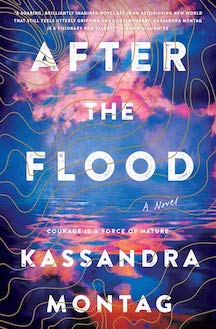
After the Flood by Kassandra Montag / Morrow / 432 pages / 2019
Synopsis: This debut novel takes place a 100 years into the future where most of Earth is covered by water and people live on boats or in mountaintop enclaves. A mother named Myra, who lives on a boat with her second daughter Pearl, intends to make a journey to find her missing first daughter (Row) who her husband has absconded with.
My Thoughts: I enjoyed listening to this one as an audiobook read by Hillary Huber. The plot — of Earth being covered mostly by water in a century’s time — I’ve been told is pretty unscientific … even if the polar ice caps were to fully melt they wouldn’t amount to that — but still I went with it.
The journey of Myra and her daughter Pearl is quite an undertaking and they run into some wily characters along the way and face various hardships. I will refrain from being more specific but you get the gist: it’s a grim outlook. The author does well describing their world and inner turmoil. I found it quite visual and suspenseful even though it’s a long story. It’s a post-apocalyptic survival tale that is about a family being pulled apart … and a mother’s never-ending quest to find her missing daughter, which held my attention from start to finish.
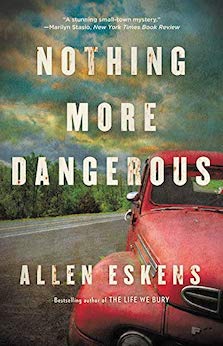
Nothing More Dangerous by Allen Eskens / Mulholland Books / 304 pages / 2019
Synopsis: The story features 15-year-old Boady Sanden who navigates the racial tensions of his high school and Jessup, Missouri in 1976. He lives with his widowed mother and becomes friends with a black boy named Thomas who moves in across the street with his family. But when Thomas’s father becomes head of the town’s largest factory, threats and bad things begin to happen. The two boys also find a body in the woods and start to investigate, making them targets of the bad seeds in town.
My Thoughts: I enjoyed this coming-of-age, small town crime story that’s been compared to William Kent Krueger’s novel “Ordinary Grace” and reminded me slightly of a male teen version of “To Kill a Mockingbird.” Eskens has a nice touch drawing in the reader and the suspense of it builds until a final reckoning that shapes their lives forever. My only slight criticism is that the boys in the story seemed a bit younger acting than 15, though perhaps that’s a bit due to taking place in 1976? All in all, it was another enjoyable tale for me from Allen Eskens, whose first novel “The Life We Bury” remains my favorite.
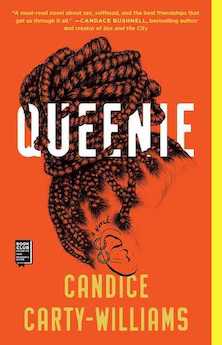
Queenie by Candice Carty-Williams / Gallery/Scout Press / 336 pages / 2019
Synopsis: This debut novel features a 25-year-old Jamaican-British woman living in London, known as Queenie, whose breakup with her white boyfriend Tom sends her on a downward spiral of self-destruction and bad choices. She then gets suspended from her British newspaper job and her self-esteem and mental health plummet … until she seeks therapy that helps rebuild her life.
My Thoughts: I’m not sure if I was the right person for this novel. During Queenie’s downward slide, there’s a lot of casual sex with a multitude of partners — some of which is abusive and was hard to take. Her fall is a bit of a darker storyline than perhaps the novel’s marketing of being like a black “Bridget Jones,” or “Sex and the City” would have you at first believe.
I was rooting for Queenie to bounce back and luckily towards the end she finally sees a therapist, which enables her to very slowly rebuild her life with her family, close friends, job, and treating herself better. This part was easier to like with her grabbing the reins of her life and asserting more control. The novel involves various issues including interracial dating, black lives matter, abuse, racism, complicated family and friends, mental health and self esteem … it covers much ground. In the end, Queenie’s transformation is a thankful reprieve.
That’s all for now. What about you — have you read any of these, and if so, what did you think?