I’ve always been a monogamous reader. I read one book at a time while giving it all my attention. I know it sounds pretty boring, right? But I thought it helped with my focus and speed of the book at hand. However just this week while I was slowed in the middle of a nonfiction book, I picked up both a novel and an audiobook. And voila, I became a multi-book reader. Not only was I breezing through a couple newspapers a day, but I was also dabbling in three books at once. Ohh it was nice! How did I not do this before?! My focus seemed undeterred, and even felt heightened, and my speed had me moving through three books at a good pace instead of languishing in one. I was able to finish the nonfiction that had dropped off for me, which was a relief. I plan to continue on with reading one nonfiction book, one novel, and listening to one audiobook at a time. I think it might be the right mix to keep things moving. How about you — are you a monogamous or polygamous reader? And how has it worked for you?
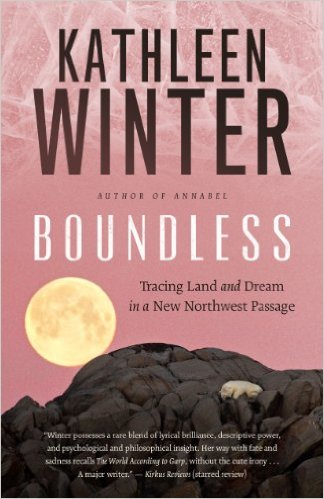
This week I finished Kathleen Winter’s 2014 nonfiction book “Boundless: Tracing Land and Dream in a New Northwest Passage.” I had liked Winter’s last book, a 2010 novel called “Annabel,” about an intersex child that is raised in a remote coastal town in Labrador, which was shortlisted for the Giller Prize. She’s an English-Canadian author who signed a copy of “Boundless” for me at our city’s book festival last fall.
The book is about a two-week summer journey Kathleen Winter took in 2010 through the storied Northwest Passage. She went aboard a ship with many others including marine scientists, historians, archaeologists, and anthropologists. With them, she visits Greenland, Baffin Island, and all along the passage, noting what it’s like in the far North and the changes going on there. It’s a travelogue of what she sees and what she learns from other passengers, a couple of whom she bonds with have Inuit backgrounds. Her book also delves a bit into her personal life and journey: emigrating from England to Canada as a child, becoming a widow with a child from her first marriage, and having another daughter in her second marriage.
“Boundless” had all the ingredients I thought I would love: part travelogue of an intriguing place, and part memoir of a successful author. Are you kidding? How many Arctic and Antarctic explorers’ books had I read over the years? A handful on Shackleton alone and a number of others as well. Gosh I was envious of Kathleen Winter going on a voyage like that. Darn her, I don’t think it even cost her much because she was the writer-in-residence onboard, but normally it’d have cost a sizable chunk of money to go. I’d need to win the lottery.
Till then it’d be Kathleen Winter’s book. And while I liked “Boundless,” it wasn’t as great as I thought or hoped it would be. It seemed uneven, some parts were quite interesting and other parts not so much. I got the gist of her outlook of trying to view things not in terms of the White Male Explorers and their northern conquests, but more in terms of the land and the Inuits or Natives. She does talk about Sir John Franklin’s lost 1845 expedition to find the Northwest Passage, especially since their ship follows his route, but her focus seems to be more on the land and Natives along the way and their cultural ways and words, which was interesting but also seemed in glimpses.
In general the book came off more as her impressions or reflections while in the North. I guess I was looking for it to be a little more substantial. It felt a bit flimsy in parts, or dreamy, as she tries to describe throughout how it feels being at one with the environment, how the land affected her, or what conversations she was having with other passengers. The book was okay but I wanted or expected more. Still many on Goodreads rated it high, and I think it would appeal to nature readers among others.
How about you — have you read any great travelogues, or natural history kinds of books? If so what were they and what did you think?