
Well last week’s U.S. Inauguration went thankfully well with no disruptions, and the singers (Lady Gaga, J.Lo, and Garth Brooks) and the youth poet laureate Amanda Gorman were quite the talk. Gorman, the youngest Inaugural poet at age 22, seemed to belt it out of the park with the reading of her inspired poem “The Hill We Climb.” For those interested, Gorman’s first poetry collection comes out Sept. 21 and to find out more about her you can check out her fun interview with CNN here.
I’m still thinking about it, but I’m also gearing up for my flight Feb. 1 to California to go stay and help my folks. There’s quite a few restrictions now on international travel, but I’m willing to meet all the requirements as I see this as essential travel. I feel good that people on the flight will all have to show a recent negative CV test result in order to board. So there’s much to do to get ready. In the meantime, I’ll leave you with reviews of two books I finished lately.
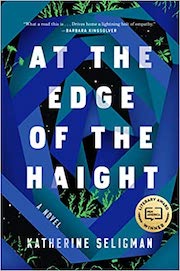
At the Edge of the Haight by Katherine Seligman/Algonquin/304 pages /2021
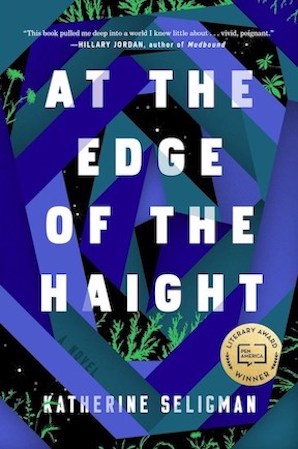
Synopsis: Seligman’s debut novel follows the life of 20-year-old Maddy Donaldo who is homeless, living with her dog Root and a few others in Golden Gate Park in San Francisco. One night after she unwittingly comes across a dying homeless boy amid the bushes and his attacker, her world is turned upside down. The police and the dead boy’s parents want to talk with her … and ultimately Maddy must decide about her life on the streets and whether to make a change or chance having a similar fate.
My Thoughts: This first-person narrated story mixes being a bit of a murder mystery with a sociological look into Maddy’s life among the homeless in San Francisco. Her close-knit group, which meanders from their make-shift camp at Golden Gate Park to the downtown streets and shelters, includes her dog Root, a pit bull mix, and her friends: Hope, Fleet, who has a pet rat named Tiny, and her boy interest Ash. Like the others, Maddy has had a tough childhood with mostly absent parents and has been at Golden Gate Park a couple years when her dog and her come upon the dying teenager and his attacker amid the bushes … and she goes running. Uh-oh.
There’s decent suspense about whether the creepy attacker will come after her, especially once she testifies at a preliminary hearing against him. A bit surprisingly, the dead boy’s parents who attend the hearing befriend Maddy — thinking perhaps she’s the last link to their homeless son even though Maddy did not know him. They want to help her, or get her to reunite with her family, though she doesn’t want their help and would rather spend time with Ash and the others. Still Maddy takes it upon herself to investigate their son’s time in the park and his death and in the process comes to do some soul-searching of her own. You will want to read till the end to see what happens.
I liked how the author blended the issues of homelessness into the story, so you become aware of them in the context. The story made apparent the backgrounds of the homeless such as Maddy; how their lives are often unpredictable and count on parks and shelters; and how they are often beaten up and harassed while on city streets by police and others. You also get a sense of the complexities of homelessness — how there are no easy fixes and how the homeless at times reject help or are unable to change. Maddy is a flawed protagonist who in that way is exasperating at times but also likably comes to try to find her way.
“At the Edge of the Haight” is not a perfect novel — it’s a bit simple in its telling and uneven — with tangents that pull from the main plot — and maybe too the dead boy’s parents seem to act to an extant a bit unlikely — but despite this I felt pretty immersed in Maddy’s story and felt the novel explored some thought-provoking and moving angles of being homeless on the streets. The author, a journalist, acknowledges in an end note the homeless people she met for the research of the book, which undoubtably lends to its authentic feel and immersive quality. It made Maddy’s story feel close-up and personal and I was rooting for her from the early pages on.
Thanks to the publisher Algonquin Books for providing me with a copy of this new novel (out Jan. 19) to review.
The Moth and the Mountain: A True Story of Love, War, and Everest
by Ed Caesar / Avid Reader / 288 pages / 2020
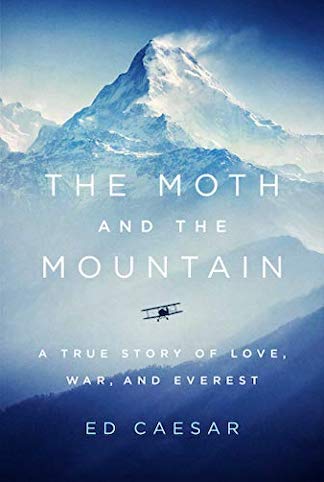
Synopsis: The true tale of one man’s attempt to be the first to climb Mount Everest in 1934.
My Thoughts: I hadn’t heard of the British mountaineer Morris Wilson before this book came out, but I love these kind of true adventure tales and this one was a whopper.
Wilson was one of those World War I veterans who fought bravely under dire circumstances during the war, eventually becoming injured by machine gun fire and sent home, forever changed by his service. He couldn’t adjust to post-war England so he traveled for several years, notably to New Zealand where he lived married for awhile and then returned home to England after shedding two wives. There he fell in love with a friend’s wife — Enid (his soul mate) — and took up a period of fasting to recuperate from an illness said to be both physical and mental.
It was while recuperating in 1932 that Wilson read about the failed attempts on Everest and decided to climb it alone. His plan was to fly a small airplane to Tibet, crash-land it on the upper slopes of Everest and walk to the summit. It was a crazy idea … especially since he was not a climber and at the time he did not yet know how to fly. Yet by April 1933 he was off in a small Gypsy Moth airplane setting his sights on Everest. His journey would be full of twists and surprises and he eventually would have to leave his plane and trek on foot (in a costume so as not to get caught) with three Sherpas from India to Everest in Tibet. His attempts on the mountain would be epic, though the first time he didn’t even know to use ice crampons for the climb.
Author Ed Caesar brings the tale and the era of Morris Wilson vividly to life despite there not being much earlier information about Wilson to go on. Some of the book recounts Caesar’s fruitless efforts to find relatives and primary sources about Wilson, which took years. But what he eventually is able to piece together through Wilson’s letters (many to his love Enid), diary entries, and the historical context is an engaging look at this man who was quite a vivacious character, lost in some ways, and very determined by his Everest obsession.
Wilson reminds me a bit of the British sailor Donald Crowhurst, who in attempting to sail alone around the world in 1968, didn’t have the skill or the experience but wanted the notoriety of the adventure and was determined to undertake the dangerous journey regardless of the warning signs. Caesar’s book points to Wilson’s trauma during WWI and how he felt the need to redeem his life and make sense of it. Whatever the case, he was quite a brave (albeit misguided) adventurer with his daring flight to India and his long trek and attempts on Everest during the early climbing era of 1934. It’s an amazing and hard to fathom true story as told in the book.
That’s all for now. What about you — have you read these — or what do you think about them? And what are you reading?